





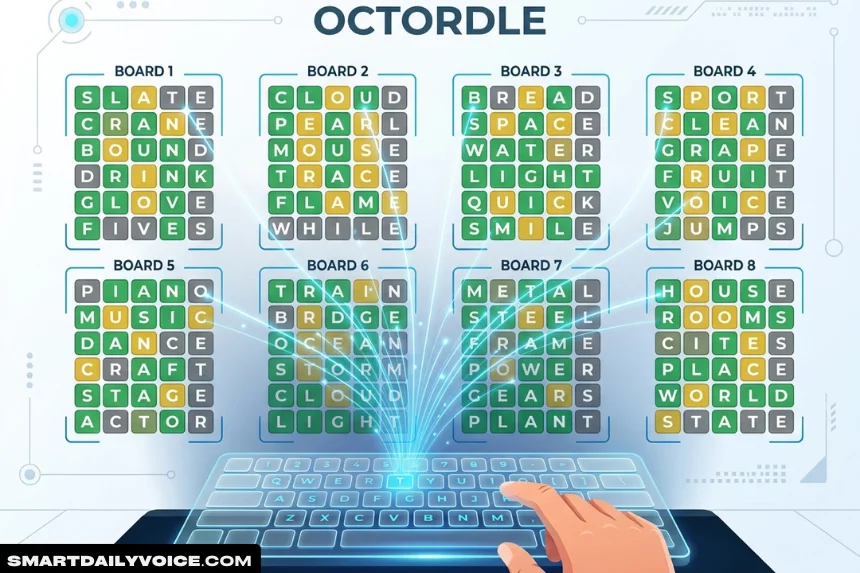
Octordle is an online word game that asks you to solve eight five-letter words at the same time. Every guess appears across all eight boards, and the standard game gives you 13 shared guesses to find every answer.
You can currently play Octordle on Merriam-Webster. However, the challenge is much greater than simply playing eight separate Wordles. Because every move affects every active board, you must balance letter discovery, word solving, and guess management from the opening move to the final answer.
This guide explains the rules, modes, archive, history, and practical strategies without revealing a daily solution. It also distinguishes the current Merriam-Webster-hosted game from third-party versions that may use different word lists, features, or scoring systems.
Octordle Quick Answer
| Question | Answer |
|---|---|
| What is Octordle? | A multi-board word puzzle with eight five-letter answers |
| Main objective | Solve all eight words before the guesses run out |
| Standard guess limit | 13 shared guesses |
| How guesses work | One submitted word applies to every unsolved board |
| Tile colors | Green, yellow, and gray indicate letter accuracy |
| Current official host | Merriam-Webster |
| Main formats | Daily/Classic, practice, Sequence, Rescue, archive, and other rotating features |
| Platform | Web browser on desktop, tablet, or phone |
| Main skills | Deduction, vocabulary, letter coverage, and board prioritization |
| Typical difficulty | Much harder than one-board Wordle |
What Is Octordle?
Octordle is a Wordle-style puzzle built around eight simultaneous answer grids. Instead of identifying one hidden five-letter word, you must identify eight words while using the same set of submitted guesses.
That shared-input design creates the game’s central tension. A guess may provide excellent information on six boards, solve a seventh, and do almost nothing for the eighth. Therefore, a strong player does not judge a word by one grid alone. The player asks how much value the guess creates across the complete puzzle.

The name combines “octo,” referring to eight, with the naming style popularized by Wordle. Although the core colors look familiar, the strategy changes dramatically as the number of boards grows.
Why is Octordle harder than Wordle?
Wordle gives you one board and normally six attempts. Octordle gives you eight boards and 13 total attempts, so you receive far fewer guesses per answer if you think of each board separately.
However, that comparison does not tell the whole story. Each opening word reveals information on every board at once. Consequently, efficient guesses can produce dozens of useful tile results. The game is difficult because you must interpret that information, remember which clues belong to which board, and switch attention at the right time.
How Does Octordle Work?
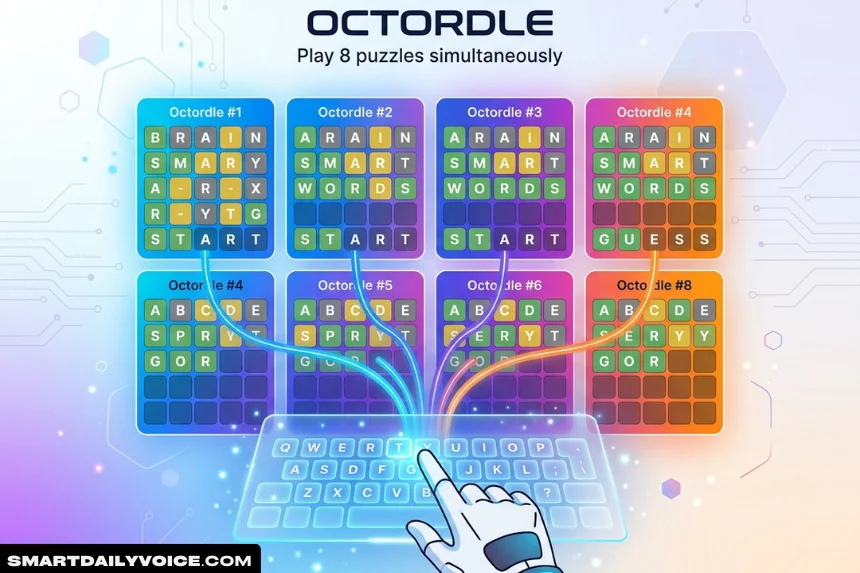
The basic rules are simple: enter a valid five-letter word, submit it, and study the color feedback on all eight grids. Continue until every board is solved or the guess counter reaches its limit.
For a current explanation inside the product, consult the Octordle tutorial. Interface labels may change over time, but the standard eight-board logic remains the defining feature.
What do green, yellow, and gray tiles mean?
A green tile means the letter is correct and appears in the correct position for that specific board. Therefore, you should normally keep that letter in that position when targeting the board.
A yellow tile means the answer contains the letter, but not in the position you guessed. You must move it to another available position. However, yellow does not tell you how many times the letter appears.
A gray tile usually means the answer does not contain that letter. Nevertheless, repeated letters require care. When a guess contains the same letter twice but the answer contains it only once, the game may color one copy and gray out the extra copy.
How can one guess affect eight boards differently?
Every board has a different answer. As a result, the same letter can turn green on one grid, yellow on another, and gray on several others.
Suppose you guess CRANE. The “A” might be green in board two, yellow in board five, and absent from board eight. You must read each grid independently even though you entered only one word.
This is also why the keyboard can feel complicated. Depending on the interface, a key may summarize several states across different boards. Instead of relying only on the keyboard, regularly inspect the actual rows on the board you plan to solve next.
How do repeated letters work?
Repeated letters follow the same basic allocation rule used in Wordle-style games. The puzzle only rewards as many copies of a letter as the answer contains.
For example, imagine the answer contains one “E,” but your guess contains two. If one “E” matches the correct location, it may turn green while the extra “E” turns gray. Similarly, one copy could turn yellow and the other gray when the answer has only one copy in a different position.
Therefore, do not automatically eliminate a letter just because one repeated copy appears gray. First check whether another copy in the same guess received green or yellow feedback.
Who Created Octordle, and When Did It Start?
Octordle emerged in early 2022 during the rapid wave of games inspired by Wordle. Contemporary coverage widely credits developer Kenneth Crawford with creating the eight-board challenge.
The available evidence supports describing Crawford as the creator or the person widely credited with the game. However, public sources do not consistently provide a detailed first-party history. Therefore, claims about a precise launch moment, development timeline, or later business transaction should be stated cautiously.
By February 2022, major gaming coverage was already discussing the game’s eight-board format. Later, the product expanded beyond the classic daily puzzle through modes such as Sequence and Rescue, as well as archives and themed challenges.
Today, Merriam-Webster hosts the main Octordle destination. That current hosting is clear. Nevertheless, a current host page alone does not establish every detail of a past acquisition, so this guide does not state an unverified purchase price or transaction date.
Where Can You Play Octordle?
The clearest current destination is Merriam-Webster’s Octordle page. It places the game inside a broader collection of dictionary-based puzzles and word resources.
You may also see independent sites using “Octordle” in a title or domain. Some provide similar eight-board gameplay, while others add unlimited play, extra languages, custom scoring, or different modes. However, those platform-specific features should not be attributed to the Merriam-Webster version.
Before you start, check three details:
- The host: Confirm which company or site operates the version.
- The rules: Check the board count, guess limit, and available modes.
- The word list: Different implementations may accept or select different words.
Consequently, two players using different websites may not receive the same puzzle, interface, or score even when both pages call the game Octordle.
Octordle Game Modes Explained
The current Octordle ecosystem has included several modes. You can review the available choices through the Octordle game hub, although menus and access rules may change.
Classic or Daily Octordle
Classic is the familiar form of the game. You see eight active boards and try to solve all eight words within 13 guesses.
The daily version normally gives players a common puzzle for that day. Therefore, friends using the same official version can compare results without sharing the answers.
Free or practice play
Practice play lets you solve additional randomly generated puzzles rather than waiting for the next daily challenge. It is the best place to test opening words and board-management methods.
Moreover, practice removes some of the emotional pressure attached to a streak. You can experiment, make mistakes, and review why a promising strategy failed.
Octordle Sequence
Sequence changes the flow of information. Instead of freely solving eight fully visible answer boards, you work through the words in an ordered progression.
The next target becomes available as you advance. Consequently, Sequence rewards careful use of information gathered from earlier guesses, but it limits your ability to choose whichever board looks easiest.
Because implementations can update their limits, check the rules shown in the game before assuming that Sequence always uses the same number of guesses as Classic.
Octordle Rescue
Rescue begins from a partly played position. The computer has already supplied opening guesses, and your task is to recover the puzzle with the clues and guesses that remain.
This mode tests adaptability rather than opening-word preparation. Instead of choosing an ideal first move, you must inspect what the existing guesses achieved, identify the weakest boards, and build a recovery plan.
Rescue is especially valuable for advanced practice. It forces you to work with imperfect information and discourages dependence on one memorized opening sequence.
Daily Gold
Daily Gold has appeared as an exclusive mode associated with Octordle Gold access. Its availability, pricing, and unlock requirements may change.
Therefore, check the current game screen before describing Gold as free, permanent, or identical for every user. The important distinction is that Gold represents an additional daily challenge rather than the standard free daily board.
Archive and themed challenges
The archive lets players return to earlier puzzles. Meanwhile, themed challenges may use categories such as animals, places, sports, or other curated vocabulary.
Theme rules can permit words that do not appear in the normal answer pool. For example, a category may include a proper place name that the standard puzzle would reject. As a result, read the challenge instructions before applying your usual dictionary assumptions.
Feature menus can change. The Octordle release notes provide useful context when the interface adds, removes, or adjusts a mode.
How to Play Octordle Step by Step
You can learn the basics in one game, but a structured process prevents early confusion.
1. Open the current game
Visit the Merriam-Webster version and choose Daily, Classic, practice, or another available mode. For your first attempt, Classic or practice provides the clearest introduction.
2. Enter a broad five-letter starting word
Choose a valid word containing common letters. A useful opener often includes two vowels and three common consonants, although no single word guarantees the best result for every puzzle.
The goal is not necessarily to solve one board immediately. Instead, you want information that helps many boards.
3. Read all eight result grids
After the first guess, scan every board. Notice where you received several green or yellow tiles and where the guess produced mostly gray tiles.
Do not commit to the first board that looks promising. First, compare the amount and quality of information across the full puzzle.
4. Consider a second coverage word
A second word with mostly new letters can greatly reduce the search space. For example, if the opener tested A, E, R, S, and T, the next word might test several common letters not used in the first guess.
However, avoid a rigid rule. If one board is almost solved and the solution itself reveals useful new letters, solving it may create more value than playing a pure coverage word.
5. Identify the most constrained board
A constrained board has enough information to leave only a few realistic answers. It may show several fixed green letters, a strong pattern, or multiple yellows with limited legal positions.
Target that board with a genuine solution candidate. If the word solves it, the same guess may also add information elsewhere.
6. Re-scan every board after each targeted guess
The most important board can change after every move. A word aimed at board three may suddenly reveal four letters on board seven.
Therefore, do not continue attacking the same grid automatically. Pause, scan, and update your priority.
7. Track the remaining-board-to-guess ratio
Near the end, compare how many boards remain with how many guesses remain. If four boards remain and only four guesses are available, you must solve a board on every move.
Ideally, enter the late game with at least one extra guess beyond the number of unfinished boards. That spare move protects you from an ambiguous final pattern.
8. Finish the dangerous board before the obvious board
An easy board with a nearly certain answer can often wait. A dangerous board with several plausible answers needs attention while you still have room to test information.
Ultimately, winning depends less on solving the easiest board first and more on preventing one uncertain board from consuming the final guesses.
Best Octordle Strategy for Beginners
A beginner should divide the puzzle into two phases: information gathering and targeted solving. Mixing those phases without a plan often wastes guesses.
Prioritize information before immediate solutions
During the first two or three guesses, measure a word by its total information value. A guess that tests five new common letters can help all eight boards, even when it does not look like a likely answer.
However, an opening guess should still be a legal word and should reflect the game’s accepted dictionary. Random strings do not help if the game rejects them.
Use common letters, but do not chase a mythical perfect opener
Letters such as E, A, R, O, T, L, I, S, N, and C occur frequently in English five-letter words. Therefore, openers that cover several of them tend to produce useful clues.
Still, the “best” starting word depends on the answer list, accepted-guess list, and scoring objective. A computer optimizer may favor a word that feels unnatural to a human. Meanwhile, a human player may perform better with an easy-to-remember pair.
Build a starting routine you understand. Then change it when the results show a weakness.
Avoid excessive letter overlap in the opening
If your first two guesses repeat three or four letters, you sacrifice an opportunity to test the alphabet. Early overlap can make sense when the first board is nearly solved, but it should be a conscious choice.
For broad discovery, aim to cover roughly eight to ten distinct useful letters across two words. In addition, include a sensible balance of vowels and consonants.
Move from global clues to targeted guesses
Coverage words create global information. Targeted words convert that information into solved boards.
The transition should happen when one or more boards have a small candidate set. If you continue playing broad coverage words after several boards become solvable, you may spend too many guesses without banking answers.
Conversely, if you target a single board after only one weak clue, you may lose the cross-board benefit of the opening phase.
Understand guess economy
Octordle is a resource-management puzzle. You have 13 moves, and you must spend them across eight answers.
A useful rule is to avoid reaching a point where the number of unfinished boards equals the number of remaining guesses unless each board has an obvious unique solution. Therefore, try to maintain a one-guess safety margin.
That margin is not always possible. Nevertheless, thinking about it from the beginning improves decision-making.
Advanced Octordle Strategy
Advanced play depends on selecting the right board and the right type of guess at each stage.
Choose the most constrained board, not always the greenest board
A board with three green letters may still have six possible answers. Meanwhile, a board with one green and three yellows may have only one legal arrangement.
Therefore, count possibilities rather than colors. Ask which board has the smallest realistic candidate set and which unresolved pattern could become dangerous later.
Maximize cross-board value
Before submitting a targeted answer, check whether its letters help other boards. Suppose two words can solve your chosen grid. One candidate repeats letters already exhausted elsewhere, while the other tests a valuable consonant on three uncertain boards.
Choose the candidate with greater cross-board value when both fit equally well. Consequently, even a failed solution attempt may provide useful elimination data.
Treat gray information as board-specific
A letter that appears gray on one board may be essential on another. This sounds obvious, yet it causes many errors when the keyboard compresses information across the whole puzzle.
Before excluding a letter, confirm that you are reading the feedback for the current board. In addition, inspect the exact row rather than relying on memory.
Handle repeated letters deliberately
Repeated letters create candidate traps such as SHEER, LEVEL, REFER, or CIVIC. A pattern may look impossible only because you assumed every yellow tile represents a different letter.
When common single-letter candidates fail, test whether a known letter could appear twice. However, do not use a duplicate-heavy word merely because duplication is possible. Look for evidence from positions and color allocation.
Manage ambiguous endings
Patterns such as _IGHT, _OUND, or S_A_E can produce several valid answers. Trying each candidate one by one may consume the game.
Instead, use a discriminator word when you have enough spare guesses. A discriminator is a legal word that tests the distinguishing letters for several candidates at once.
For example, if a final board could be LIGHT, MIGHT, NIGHT, or RIGHT, a word containing several of L, M, N, and R may identify the answer more efficiently than guessing each candidate. Nevertheless, a discriminator only makes sense when you have a spare move and when it also benefits other boards.
Abandon an unproductive board temporarily
Tunnel vision is expensive. If two guesses aimed at one board fail to reduce its candidate set, switch to another grid.
A solution elsewhere may test letters that clarify the difficult board indirectly. Meanwhile, finishing another word reduces visual clutter and lets you focus on fewer active patterns.
Protect the final guess
Before the endgame, identify the board most likely to contain an obscure word or an ambiguous family. Give that board attention early enough to preserve a test move.
Players often lose after solving seven boards because they leave the least informative pattern for last. Therefore, endgame planning begins several guesses before the final row.
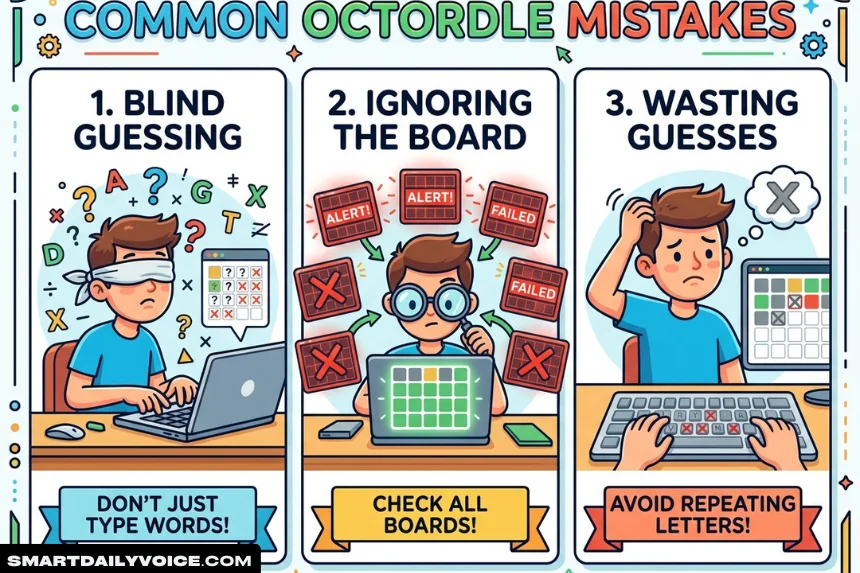
Common Octordle Mistakes
The fastest way to improve is to remove repeatable errors.
Chasing one board too early
A first guess may produce three promising tiles on one grid. However, spending the next two moves only on that grid can leave seven boards underexplored.
Use at least one broad information move unless the immediate solution is highly likely and also provides useful letters elsewhere.
Reusing gray letters without a reason
Once a letter is gray on the target board, do not include it again unless the word serves a deliberate cross-board or discrimination purpose.
Repeated gray letters reduce the information available to that board. Consequently, accidental reuse can turn a valuable guess into a wasted move.
Forgetting duplicate letters
A board may remain unsolved because you assume each letter appears once. Reconsider duplication when a pattern resists normal candidates.
However, do not swing to the opposite extreme and guess double letters constantly. Let the clue pattern support the possibility.
Solving obvious boards while ignoring dangerous ones
An obvious answer feels satisfying, but it may not be urgent. If another grid has a large ambiguous family, use your flexible guesses there first.
You can return to the obvious board later, provided its answer truly appears unique. This approach keeps one difficult grid from destroying an otherwise strong game.
Misreading yellow tiles
Yellow means the letter exists somewhere else in that answer. It does not mean the letter belongs in the nearest empty position.
List the forbidden positions, then consider every remaining legal location. As a result, you avoid repeatedly moving a yellow letter between two incorrect spots.
Trusting a combined keyboard too much
Multi-board keyboard displays must summarize several states at once. Depending on the version, the visual treatment may be split, layered, or prioritized.
Therefore, use the board rows as the final authority. The keyboard is a navigation aid, not a substitute for reading each grid.
Looking up the answer too soon
Daily answer pages remove the deduction that makes the game rewarding. Instead, take a short break, review candidate families, or replay archived puzzles for practice.
If you need vocabulary support after finishing, use the Merriam-Webster Word Finder to explore legal patterns and learn unfamiliar words.
How to Read and Share an Octordle Score
After a completed puzzle, Octordle can display a shareable summary that represents the order or guess number on which each board was solved. The exact visual format can change with interface updates.
In general, lower solve numbers indicate that a board was completed earlier. A failed or unfinished board receives a different marker. However, do not assume that every third-party Octordle clone uses the same symbols or scoring formula.
When sharing a daily result, avoid adding the answer words. A spoiler-free grid lets friends compare performance while preserving the puzzle.
Also confirm that everyone played the same version and date. Otherwise, identical puzzle numbers or layouts cannot be assumed.
Octordle Archive and Past Puzzles
The official Octordle archive gives players access to past puzzles where available. It is useful for practice, missed days, and strategy testing.
Archive play offers a better learning environment than immediately reading daily answers. You can test a new opening pair across several historical boards and observe whether it produces reliable letter coverage.
Moreover, the archive can expose recurring weaknesses. For example, you may discover that you mishandle double letters, delay difficult boards, or spend too many moves on coverage.
Do not assume that an archived result changes an official daily streak in a particular way unless the current interface explains that behavior. Streak and history rules can change, especially when account, storage, or backup systems evolve.
Octordle vs Wordle, Dordle, Quordle, and Sedecordle
These games share a color-feedback foundation, but the number of boards changes the strategy.
| Game | Typical number of boards | Common guess limit | Main strategic challenge |
| Wordle | 1 | 6 | Solve one word efficiently |
| Dordle | 2 | 7 | Balance two answer grids |
| Quordle | 4 | 9 | Use shared guesses across four boards |
| Octordle | 8 | 13 | Manage information and priorities across eight boards |
| Sedecordle | 16 | Often 21 | Control a much larger set of simultaneous patterns |
Limits and features may vary across implementations. Nevertheless, the general progression is clear: more boards increase the value of broad letter coverage while also increasing the risk of overlooking one difficult pattern.
Octordle vs Wordle
Wordle allows deeper focus on a single candidate set. Octordle requires frequent attention switching.
Furthermore, a Wordle guess can be judged entirely by one answer. An Octordle guess must justify itself across eight boards. Therefore, a word that looks inefficient in Wordle may have strong cross-board value in Octordle.
Octordle vs Quordle
Quordle sits between Wordle and Octordle. It uses four boards, so players can often track every pattern without as much scrolling or note-taking.
Octordle doubles that board count. Consequently, board prioritization becomes more important, and the endgame can punish one neglected grid more severely.
Octordle vs larger multi-board games
Games with 16 or 32 boards amplify the same shared-input idea. They may provide more guesses, but the visual and memory load grows substantially.
Octordle remains a useful middle ground for experienced Wordle players. It is difficult enough to demand planning, yet it remains possible to review all eight boards after each move.
Is Octordle Good for Vocabulary Practice?
Octordle can support informal vocabulary practice because it exposes players to spelling patterns, letter combinations, and unfamiliar five-letter words. In addition, repeated play encourages careful attention to word structure.
However, no Octordle-specific clinical evidence establishes that the game improves intelligence, prevents cognitive decline, or treats a health condition. It is more accurate to describe it as an entertaining word puzzle that may encourage vocabulary exploration and logical deduction.
To learn from a surprising answer, look it up after the game. Read its definition, pronunciation, and example use. Then try to connect it with related words rather than memorizing it as an isolated solution.
This post-game habit turns a confusing answer into a vocabulary lesson without spoiling the live puzzle.
Why Did Octordle Become Popular?
Octordle arrived when Wordle-inspired games were spreading rapidly. Players already understood the green-yellow-gray language, so they could start without learning an entirely new system.
At the same time, the eight-board format offered a clear escalation. It appealed to people who had grown comfortable with Wordle or Quordle and wanted a longer, more demanding daily ritual.
Shareable results also helped. Players could compare scores without publishing answer words, which supported friendly competition.
The game has attracted well-known fans as well. Bill Gates publicly described Octordle as a daily habit alongside Wordle and Nerdle. That statement does not provide player statistics, but it demonstrates the game’s reach beyond dedicated puzzle communities.
How to Make Octordle Easier Without Spoiling It
You can reduce frustration while keeping the puzzle fair.
First, write brief notes for the hardest board. Record fixed positions, present letters, excluded letters, and likely repeated characters. Although the interface stores the tiles, a one-line pattern can reduce visual overload.
Second, step away for a few minutes. A fresh look often reveals a common word family that tunnel vision hid.
Third, use practice and archive modes. Repetition builds faster recognition of patterns such as consonant clusters, vowel placement, and duplicate letters.
Fourth, review the current tutorial when a color result seems inconsistent. The issue may involve repeated letters rather than a bug.
Finally, use reference tools after the puzzle rather than searching for the daily answer during it. Consequently, you preserve the satisfaction of deduction while still learning from unfamiliar vocabulary.
Octordle FAQ
1. What is Octordle?
Octordle is a multi-board word game in which you solve eight five-letter words at the same time. Each submitted guess applies to every unsolved board, so the standard 13 guesses must be managed carefully.
2. How many guesses do you get in Octordle?
The standard Classic game gives you 13 shared guesses to solve all eight words. However, special modes such as Sequence or Rescue may use different starting conditions or limits, so check the current instructions.
3. Is Octordle harder than Wordle?
Yes, Octordle is generally harder because it requires you to track eight answer grids instead of one. Nevertheless, each guess gives information across all boards, which makes efficient letter coverage extremely powerful.
4. Where can I play the official Octordle?
The current main version is hosted on Merriam-Webster’s games website. Third-party alternatives also exist, but their word lists, modes, ads, statistics, or scoring may differ.
5. Is Octordle free?
The standard daily or classic experience has been available without a separate purchase. However, premium or Gold features may have different access rules, so review the current game screen before assuming every mode is free.
6. What is Octordle Sequence?
Sequence is a mode in which you progress through the answer words in order rather than freely choosing among eight fully active boards. Consequently, it emphasizes planned progression and careful use of clues.
7. What is Octordle Rescue?
Rescue gives you a puzzle that already contains computer-selected opening guesses. You must analyze the existing clues and solve the remaining boards with limited room for recovery.
8. Can I play old Octordle puzzles?
Yes, the Merriam-Webster Octordle archive provides access to earlier puzzles where available. Moreover, archived games are useful for testing opening words and improving strategy without reading spoilers.
9. What are the best starting words for Octordle?
Strong starting words usually cover common vowels and consonants with little overlap. Instead of copying one “perfect” word, build a pair that tests many useful letters and that you can interpret quickly.
10. Does Octordle have the same answer for everyone?
Players using the same official daily puzzle normally receive the same set for that date. However, practice modes and third-party websites can generate different words, so confirm the platform before comparing results.
Conclusion
Octordle turns a familiar five-letter puzzle into an eight-board exercise in deduction and resource management. You normally receive 13 shared guesses, and every submitted word must create value across several grids.
The most reliable strategy has two stages. First, use information-rich guesses to reveal common letters across the complete puzzle. Then, target the most constrained or dangerous board while preserving enough guesses for an ambiguous ending.
Above all, avoid tunnel vision. Re-scan every grid after each move, respect repeated-letter clues, and keep a safety margin whenever possible. With practice, Octordle becomes less like eight chaotic Wordles and more like one connected logic puzzle.