





Bruce Nolan is a longtime New Orleans journalist best known for his work at The Times-Picayune. He spent 41 years at the newspaper, covering New Orleans as a reporter, editor, columnist, and suburban bureau chief. Readers often connect his name with religion reporting, Hurricane Katrina coverage, and the city’s changing newspaper era.
Nolan’s career stands out because he reported on New Orleans from inside the community for decades. He covered public life, religion, disaster, recovery, politics, education, and civic change. Jesuit High School of New Orleans, his alma mater, reported that the Press Club of New Orleans honored him with a 2017 Lifetime Achievement Award for his long record of journalism in the city.
Who Is Bruce Nolan in New Orleans?
Bruce Nolan is a New Orleans journalist and former Times-Picayune staff member. He graduated from Jesuit High School of New Orleans in 1965 and built his professional reputation at The Times-Picayune, where he worked from 1971 to 2012.
He became especially known for covering religion in New Orleans. The Clarion Herald described Nolan as a former Times-Picayune reporter who covered the city’s religious landscape for the last 18 years of his career. The same source later described him as a part-time tour guide who explains New Orleans to visitors.
Bruce Nolan’s Times-Picayune Career
Nolan spent his entire 41-year newspaper career at The Times-Picayune. Jesuit High School’s 2017 profile says he worked as a reporter, editor, columnist, and suburban bureau chief between 1971 and 2012. The same profile says he formed part of the Times-Picayune team that earned a Pulitzer Prize for Hurricane Katrina coverage.
His reporting career covered many parts of New Orleans life. The Press Club of New Orleans, quoted in Jesuit’s profile, praised his work across crime, education, politics, religion, disaster, and recovery.
That range matters because New Orleans is not an easy city to explain. Reporters covering the city often need historical knowledge, cultural fluency, and a deep understanding of neighborhoods, churches, politics, race, class, and disaster recovery. Nolan’s long career gave him that context.
His Religion Reporting
Bruce Nolan became one of New Orleans’ notable religion reporters. GetReligion wrote in 2010 that Nolan had spent his career at The Times-Picayune and, after earlier roles as reporter, suburban bureau chief, and assistant city editor, began covering religion in 1994 after requesting a six-month sabbatical to return to writing.
His religion coverage did not focus only on church events. It often connected faith to public life, disaster, ethics, neighborhood recovery, Catholic institutions, clergy abuse, religious politics, and post-Katrina rebuilding.
National Catholic Reporter lists many of Nolan’s religion-related stories, including articles on New Orleans church closings, Catholic school discipline, archdiocesan slave records, abuse settlements, and Hurricane Katrina’s impact on Catholic parishes.
The Christian Century also lists Bruce Nolan as a contributor and describes him as writing for The Times-Picayune of New Orleans. Its author page includes religion and public-life stories from 2010 to 2012.
Bruce Nolan and Hurricane Katrina Coverage
Hurricane Katrina shaped the final stretch of Nolan’s newspaper career. In a 2010 GetReligion interview, Nolan said he was aboard a Times-Picayune delivery truck that re-entered flooded New Orleans after helping move employees out of the city. He called Katrina “the first day of the last story” of his career because the disaster continued to affect nearly everything the newsroom did afterward.
That quote helps explain why Nolan’s New Orleans work carries local weight. Katrina was not only a disaster story. For New Orleans journalists, it became a long-running story about loss, government failure, rebuilding, faith, trauma, migration, and whether the city could hold itself together.
Nolan also wrote about religious responses to Katrina and later disasters. Sojourners lists several of his New Orleans religion stories, including reports on Hurricane Isaac cleanup, synagogues reopening after Katrina, and faith-based rebuilding efforts.
2017 Lifetime Achievement Award
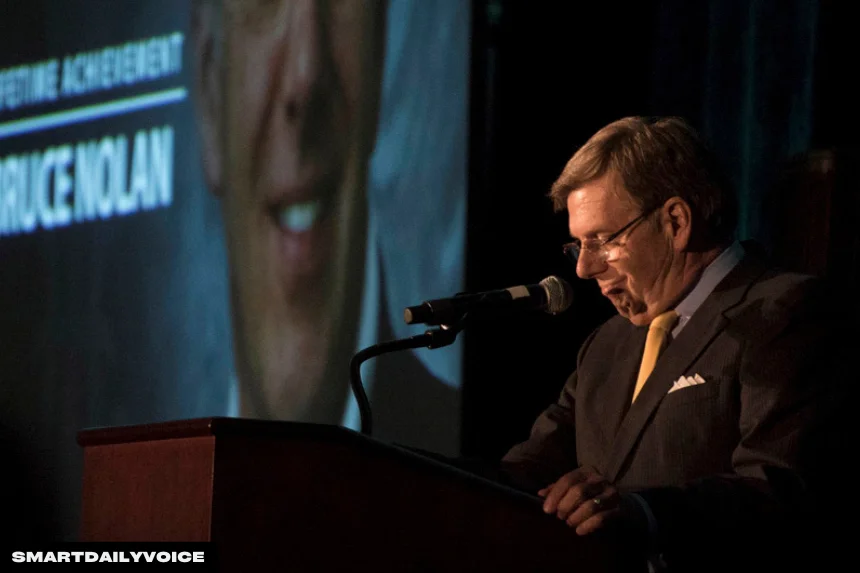
In 2017, the Press Club of New Orleans honored Bruce Nolan with a Lifetime Achievement Award during its 59th Annual Excellence in Journalism Awards Gala. Jesuit High School reported the award and noted Nolan’s connection to its Class of 1965.
The award recognized more than longevity. It recognized a career built around sustained local reporting. The Press Club message quoted by Jesuit praised Nolan’s commitment to timely, compelling news on issues that affected communities every day.
Bruce Nolan and The Times-Picayune’s 2012 Shift
Nolan’s name also appears in coverage of The Times-Picayune’s controversial 2012 move away from daily print publication. The Guardian reported that Nolan, then a 41-year veteran of the paper, had been laid off and later declined an offer to return. He described the community’s adjustment to a city without the regular daily Times-Picayune at the curb.
MyNewOrleans also described Nolan’s remarks during a tense Times-Picayune staff meeting after news of major changes broke. The magazine called him a 41-year veteran and noted his reputation as an even-tempered, deeply religious family man.
That period marked a major moment in New Orleans media history. For many readers and journalists, The Times-Picayune represented a civic institution, not just a newspaper. Nolan’s comments captured the emotional weight of that transition.
Is This the Same Bruce Nolan as the Navy Veteran?
No. Search results can mix different people named Bruce Nolan.
The New Orleans journalist Bruce Nolan worked for The Times-Picayune and graduated from Jesuit High School of New Orleans. A different Bruce Nolan, listed by the Smithsonian National Air and Space Museum, is LCDR Bruce D. Nolan, USN, a Navy aviation figure who grew up in New Orleans and attended Brother Martin High School.
Readers should not combine those biographies. They refer to different people with the same name and a New Orleans connection.
Why Bruce Nolan Matters to New Orleans Journalism
Bruce Nolan matters because his career shows how local journalism preserves a city’s memory. He reported through decades of civic change, religious controversy, disaster recovery, and newsroom disruption.
His work also reflects a type of reporting that depends on long-term local knowledge. A reporter can cover a city event in one day, but understanding New Orleans often takes years. Nolan’s career gave readers that continuity.
FAQs
Who is Bruce Nolan in New Orleans?
Bruce Nolan is a longtime New Orleans journalist and former Times-Picayune reporter, editor, columnist, and suburban bureau chief. He worked at the paper from 1971 to 2012.
What is Bruce Nolan known for?
He is known for his 41-year Times-Picayune career, religion reporting, Hurricane Katrina-related coverage, and his role in New Orleans journalism.
Did Bruce Nolan work for The Times-Picayune?
Yes. Jesuit High School reported that Nolan spent his 41-year journalism career at The Times-Picayune from 1971 to 2012.
Did Bruce Nolan win a journalism award?
Yes. The Press Club of New Orleans honored him with a 2017 Lifetime Achievement Award at its Excellence in Journalism Awards Gala.
What did Bruce Nolan cover?
He covered several areas over his career, including crime, education, politics, religion, disaster, and recovery. He became especially associated with religion reporting in New Orleans.
Is Bruce Nolan still in New Orleans?
The Clarion Herald described Nolan as a former Times-Picayune reporter and part-time tour guide who explains New Orleans to tourists. That source does not provide a full current personal profile, so readers should avoid assuming more than public sources confirm.
Conclusion
Bruce Nolan is a respected New Orleans journalist whose name is closely tied to The Times-Picayune, religion reporting, and Hurricane Katrina-era coverage. His 41-year career gave readers a long view of the city’s public life, faith communities, disasters, and recovery. Public sources also show why readers should distinguish him from other people named Bruce Nolan, including the unrelated Navy veteran with a New Orleans background.
Discover more on our website about tom hanks pedophelia