





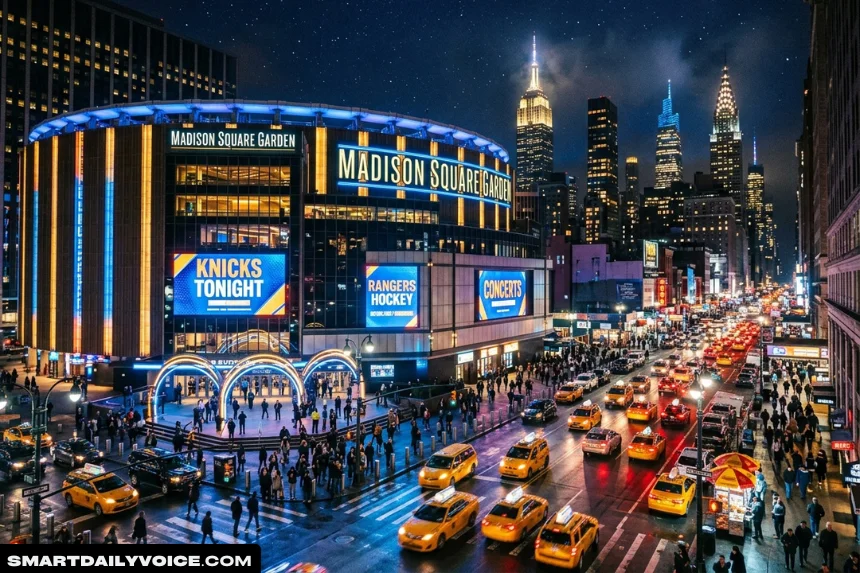
Madison Square Garden is a multipurpose indoor arena at 4 Pennsylvania Plaza in Midtown Manhattan, directly above New York Penn Station. Often called “MSG” or “The Garden,” it serves as the home arena of the New York Knicks and New York Rangers while also hosting concerts, boxing, college basketball, comedy, family entertainment, and major civic events.
For first-time visitors, the most important facts are simple: check the event-specific seat map before buying, use public transportation when practical, travel light, and review the venue’s latest rules before leaving home. Because the event calendar, entrance instructions, stage layouts, and security policies can change, an evergreen guide should explain how the building works while directing readers to official updates.
Madison Square Garden Quick Answer
| Question | Direct answer |
|---|---|
| What is Madison Square Garden? | A major indoor sports and entertainment arena in Midtown Manhattan |
| Where is Madison Square Garden? | 4 Pennsylvania Plaza, between Seventh and Eighth avenues and West 31st and 33rd streets |
| When did the current arena open? | February 11, 1968 |
| What teams play there? | The NBA’s New York Knicks and the NHL’s New York Rangers |
| How many people does it hold? | Capacity varies by setup; the arena generally accommodates roughly 18,000 to 20,000 spectators |
| What events take place there? | Basketball, hockey, concerts, boxing, wrestling, comedy, family shows, college sports, and special events |
| What is the nearest transit hub? | New York Penn Station, directly beneath the arena |
| What is it commonly called? | MSG, The Garden, and “The World’s Most Famous Arena” |
| Can visitors tour it? | Yes, when tours are available around the event schedule |
| Primary keyword | Madison Square Garden |
What Is Madison Square Garden?
In addition, Madison Square Garden is both a working arena and a New York cultural landmark. Unlike a stadium designed mainly for one sport, it can convert between basketball, hockey, concerts, combat sports, award-style productions, and other large indoor events. Consequently, the floor plan, stage position, available seats, entrances, and even the atmosphere can differ significantly from one date to another.
Meanwhile, the current building is the fourth venue to carry the Madison Square Garden name. Although its title suggests a site near Madison Square Park, today’s arena stands about a mile north and west of the square that inspired the name. Its placement above Penn Station also makes it unusual: visitors can arrive by subway or regional rail and reach the venue without traveling to an isolated stadium district.
Moreover, MSG operates as a symbol as much as a building. Athletes often treat a game there as a major occasion, while musicians view a headline concert at The Garden as a career milestone. That reputation comes from decades of championship games, celebrated boxing cards, record-setting concerts, political gatherings, religious visits, and nationally televised events.

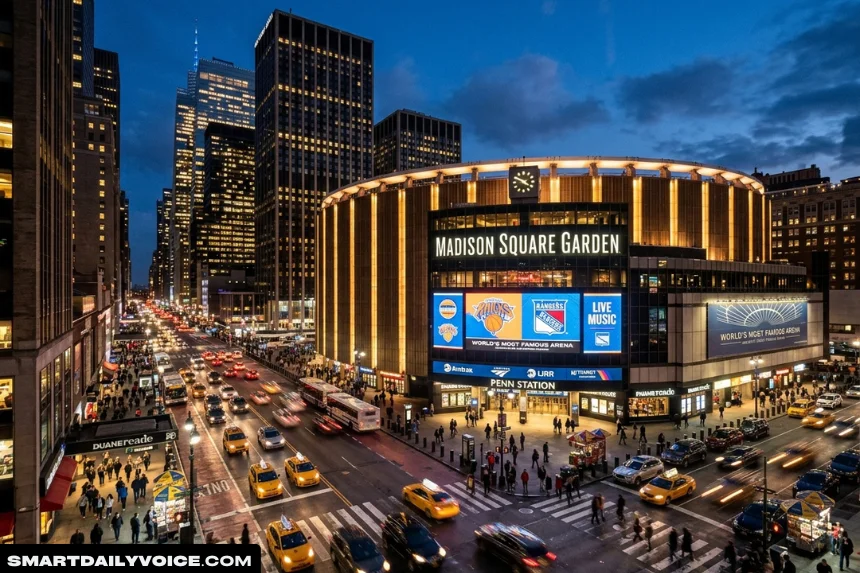
Madison Square Garden key facts
| Fact | Verified summary |
| Official address | 4 Pennsylvania Plaza, New York, NY 10001 |
| Neighborhood | Midtown Manhattan |
| Current arena opening | February 11, 1968 |
| Building generation | Fourth Madison Square Garden |
| Main professional tenants | New York Knicks and New York Rangers |
| Main uses | Sports, concerts, comedy, family shows, tours, and special events |
| Transit connection | Built above New York Penn Station |
| Typical capacity | Event-dependent, generally around 18,000–20,000 |
| Official event source | MSG’s current event calendar |
| Visitor-policy source | MSG’s venue FAQs and event detail page |
Why Is It Called Madison Square Garden?
The name comes from the first two arenas, which stood near Madison Square in Manhattan. Madison Square itself takes its name from James Madison, the fourth president of the United States. Therefore, the “Madison” in the arena’s name does not describe its present neighborhood or its current street address.
The word “Garden” reflected a nineteenth-century convention for large public entertainment spaces. At the time, indoor venues often adopted elegant or leisure-oriented names rather than labels such as arena or stadium. Eventually, “Madison Square Garden” became such a valuable identity that its owners kept the name even after moving the venue away from Madison Square.
For example, readers who want a broad reference overview can explore the Madison Square Garden background page on Wikipedia. However, official pages and institutional sources remain better choices for current schedules, policies, accessibility details, and ticket instructions.
Madison Square Garden History: Four Arenas, Three Sites
However, the story of Madison Square Garden does not begin with the circular building above Penn Station. Instead, it spans four arenas, three locations, and nearly a century and a half of New York entertainment history. Each version reflected the city’s changing architecture, transportation patterns, sports culture, and appetite for large public spectacles.
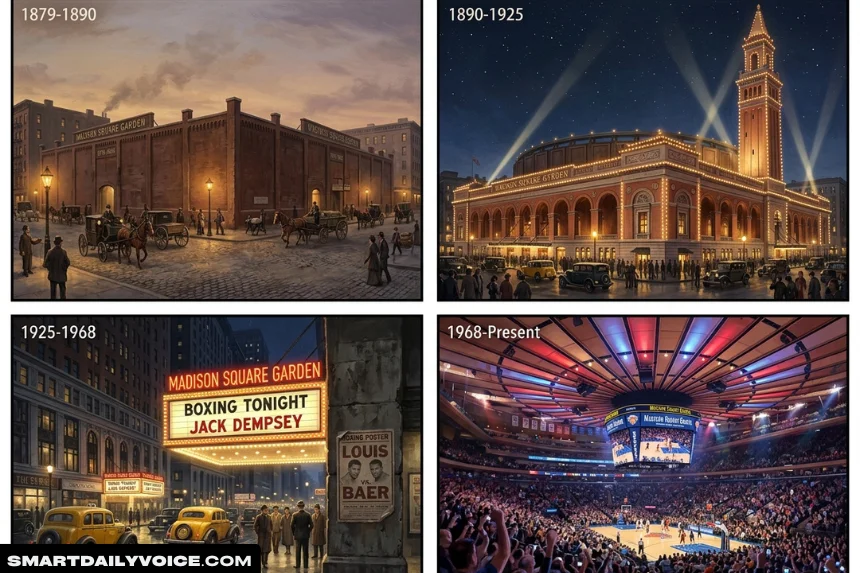
The first Garden: 1879–1890
Initially, the first venue opened in 1879 near Madison Avenue and East 26th Street. It evolved from an earlier rail-depot and entertainment space and hosted sporting exhibitions, circuses, shows, and public gatherings. Nevertheless, the building faced structural and financial limitations, so it lasted only about a decade.
Its importance went beyond its lifespan. The venue established a link between the Madison Square name and large-scale entertainment. As a result, the identity survived even when the original structure did not.
The second Garden: 1890–1925
Later, a much more elaborate second building opened on the same general site in 1890. Architect Stanford White designed a prominent structure with a tower, entertainment rooms, performance areas, and a roof garden. For a time, it stood as one of the neighborhood’s defining landmarks.
However, the building proved expensive to operate. It closed in 1925, and the New York Life Insurance Building later rose on the site. The Madison Square Park Conservancy’s account of the first two venues provides useful local historical context, while MSG’s own official history of Madison Square Garden highlights the larger legacy carried into the present arena.
The third Garden: 1925–1968
Afterward, the third Madison Square Garden moved away from Madison Square to Eighth Avenue between West 49th and 50th streets. Boxing promoter Tex Rickard drove the project, and the building quickly became associated with boxing, hockey, basketball, political meetings, rallies, and stage events.
This arena helped establish the Garden as a national sports address. The New York Rangers began play there during the 1920s, and the Knicks later used it as their home. Meanwhile, major boxing events strengthened the venue’s reputation as a place where careers and championships could change in a single night.
The third building closed when the current Garden opened in 1968. Its site eventually became part of the Worldwide Plaza development.
The current Garden: 1968 to the present
Ultimately, the present arena opened on February 11, 1968, above Penn Station on Manhattan’s West Side. Its circular form and cable-supported roof created a large, column-free interior bowl. In addition, its transit connection placed the building at the center of rail and subway networks serving New York City and the wider region.
The move carried architectural controversy because construction followed the demolition of the above-ground portions of the original Pennsylvania Station. That loss helped energize New York’s historic-preservation movement. Consequently, the current Garden belongs to two overlapping stories: the rise of a globally known entertainment arena and the debate over how New York balances development with architectural heritage.
Renovations and the modern arena
Similarly, the building has undergone major renovations rather than replacement. Work around 1990 updated the arena, while a three-year transformation completed in 2013 changed concourses, hospitality areas, technology, seating experiences, food service, and circulation.
Nevertheless, the basic identity remained recognizable. The distinctive roof, central location, and steep arena bowl continued to shape the experience. Today, visitors encounter a venue that combines a 1960s structural concept with modern video, premium seating, concessions, accessibility features, and event-production systems.
A Madison Square Garden Timeline
| Year | Development |
| 1879 | The first Madison Square Garden opens near Madison Square |
| 1890 | The second Garden opens on the same general site |
| 1925 | The third Garden opens on Eighth Avenue near West 50th Street |
| 1926 | The New York Rangers begin their first season |
| 1946 | The New York Knicks franchise begins play |
| 1968 | The current Garden opens above Penn Station |
| 1970 | The Knicks win an NBA championship, creating one of the arena’s signature sports memories |
| 1971 | Muhammad Ali and Joe Frazier meet in the “Fight of the Century” |
| 1973 | The Knicks win another NBA championship |
| 1994 | The Rangers complete a Stanley Cup championship season |
| 2011–2013 | MSG completes a major three-year transformation |
| Present | The arena continues to host the Knicks, Rangers, concerts, combat sports, college basketball, and special events |
What Events Take Place at Madison Square Garden?
Today, Madison Square Garden hosts a rotating mix of sports and entertainment. Therefore, people searching the venue’s name may have very different goals: one reader may want tonight’s concert, another may need a Knicks seat map, and another may be planning a sightseeing tour.
The venue’s official online calendar remains the best place to confirm current events and dates. Event listings change frequently, and postponements, added performances, playoff schedules, production holds, and ticket releases can alter availability. For that reason, an article should not present a long static event list as though it will remain current.
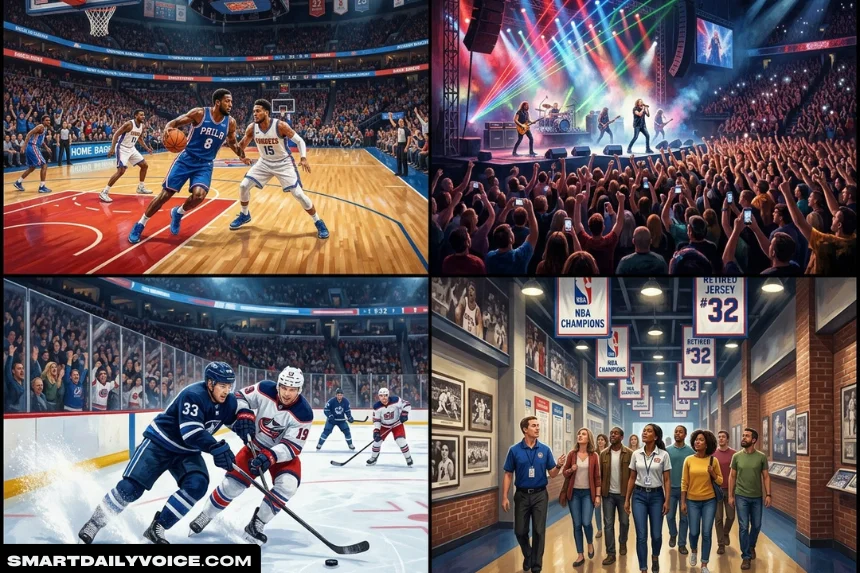
New York Knicks basketball
For example, the New York Knicks use The Garden as their home arena. Basketball creates one of the venue’s most familiar layouts, with lower-bowl, club, suite, upper-level, and bridge seating surrounding the court.
A Knicks game adds entertainment beyond the action itself, including introductions, music, video-board segments, and in-arena promotions. However, playoff games, rivalry matchups, weekend dates, and visits by high-profile players can affect ticket demand and prices.
New York Rangers hockey
Similarly, the New York Rangers also call Madison Square Garden home. For hockey, the rink changes sightlines and reduces capacity compared with some basketball or concert layouts.
Seats near center ice usually provide a balanced view of both ends. Meanwhile, seats behind a goal can bring fans closer to scoring chances, board battles, and protective netting. Because the boards and glass influence the view, buyers should inspect the hockey-specific map rather than relying on a basketball diagram.
Concerts
Meanwhile, concerts can transform MSG more dramatically than team sports. Some productions place the stage at one end, while others use a center stage, extended runway, general-admission floor, or seats behind the performance area. Consequently, the same section may offer an excellent view for one tour and a limited or unusual angle for another.
Sound also depends on production design, speaker placement, seat location, and the performer’s setup. Although The Garden has a celebrated concert reputation, no universal “best concert section” applies to every show. The event-specific map matters more than a generic venue chart.
Boxing, wrestling, and mixed martial arts
In addition, combat sports form a major part of the Garden’s identity. Historic boxing matches helped create its mythology, and modern boxing, professional wrestling, and mixed martial arts events continue that tradition.
For these events, floor seats can provide proximity but may also create obstructed sightlines when people stand. Elevated lower-bowl seats often offer a clearer view into the ring or cage. Therefore, buyers should balance closeness against viewing angle.
College basketball and special sports
Likewise, college basketball has a long relationship with the arena. Tournaments, showcases, and St. John’s games regularly bring campus traditions into a professional-sized venue.
In addition, MSG can host figure skating, tennis exhibitions, esports, gymnastics, and other special competitions when scheduled. The building’s flexibility allows it to change quickly, although every conversion creates a distinct seating and entry plan.
Comedy, family shows, and special events
Moreover, comedy tours, children’s productions, cultural programs, graduations, and large private events also use the complex. Some dates may take place in the smaller theater within the Madison Square Garden complex rather than the main arena. Therefore, visitors should verify the exact venue name on the ticket.
This distinction matters because the arena and the theater have different entrances, capacities, layouts, and guest experiences. A ticket that says the theater at MSG should not be treated as a main-arena ticket.
Madison Square Garden Seating Guide
Therefore, there is no single best seat at Madison Square Garden. Instead, the right choice depends on the event, production layout, budget, height preference, mobility needs, and whether the viewer prioritizes closeness, a complete visual picture, or atmosphere.
Before buying, open the official Madison Square Garden seating chart and then select the specific event whenever possible. MSG explicitly notes that stage setups and seat configurations vary. Therefore, generic section advice should always remain secondary to the live event map.
Floor seats
For example, floor seats can feel immersive at concerts, boxing cards, and wrestling shows. They place the guest close to the action, and they may provide a memorable sense of scale.
However, a flat floor creates a simple problem: people in front can block the view. In addition, a distant floor row may offer a worse visual angle than an elevated lower-bowl seat. Buyers should consider their height, the stage elevation, whether the floor is seated or standing, and the location of production equipment.
The 100 level
Similarly, the 100-level bowl often provides a strong blend of proximity and elevation. For basketball, side-court sections can show spacing and movement clearly. For hockey, seats near center ice offer balanced views, while corner sections can deliver dramatic angles into the attacking zones.
For concerts, lower-bowl value changes with stage location. Sections beside the stage can be close but sharply angled. Meanwhile, sections facing the stage from farther away may show the full production more clearly.
The 200 level
Meanwhile, the 200 level can offer a broader view at a lower price than premium lower sections. Many visitors prefer this perspective because it reveals formations, lighting, video elements, and crowd movement.
Nevertheless, rows and section positions matter. Some upper rows can feel high, and production structures may affect selected concert views. Therefore, compare the exact row, not only the section number.
Bridge and upper seating
In contrast, the bridge areas create a distinctive overhead perspective. Some fans enjoy the unusual view and convenient nearby amenities. Others prefer a more traditional angle from the lower bowl.
Upper sections usually provide the most affordable way to enter the building. Although they are farther from the floor, they can still deliver the arena’s crowd energy. For events where atmosphere matters more than facial detail, a high seat may provide good overall value.
Suites, clubs, and premium hospitality
Moreover, premium products can include private suites, club access, lounges, dedicated service, and upgraded food options. These packages suit corporate groups, celebrations, and buyers who prioritize comfort or hospitality.
However, premium does not automatically mean closest. Some spaces trade proximity for privacy, amenities, or a wider social area. Buyers should review both the included benefits and the actual sightline before committing.
Limited-view and behind-stage seats
However, limited-view seats may reduce the price, but the restriction can range from minor to substantial. A speaker stack, stage wall, lighting tower, camera platform, railing, or scoreboard can affect the experience.
Behind-stage concert seats can sometimes provide a surprisingly close view when the production remains open at the rear. Nevertheless, other tours block much of the performance. The event map, ticket disclosure, and production design should guide the decision.
How to choose the best seat
Start by deciding what matters most. For sports, a complete tactical view often favors elevation and a central angle. For concerts, closeness may matter more, although a front-facing view can better reveal screens, lighting, and staging.
Next, compare the row as well as the section. Then check whether the ticket mentions side view, rear view, obstructed view, or limited view. Finally, compare the price difference with the likely improvement rather than assuming the most expensive listing is automatically the best choice.
How to Visit Madison Square Garden
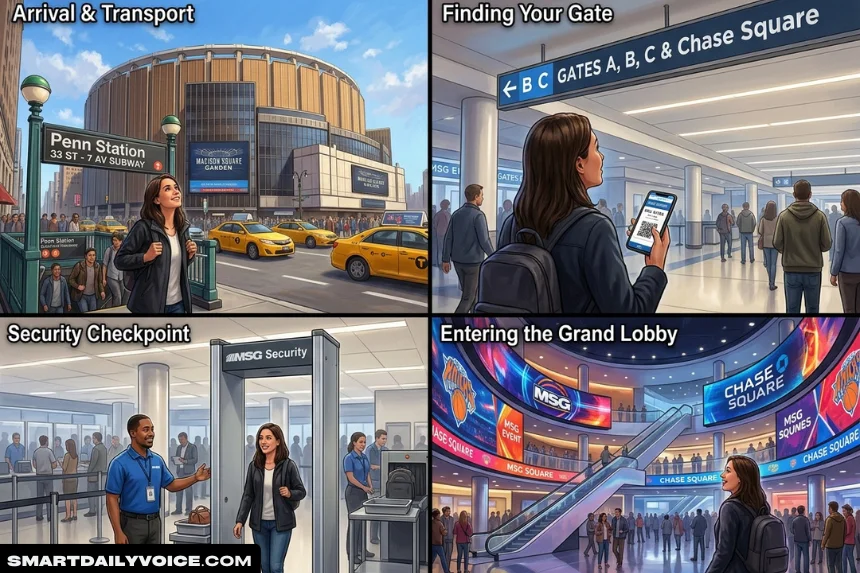
Therefore, a smooth visit begins before arrival. Because The Garden sits in one of Manhattan’s busiest transportation and commercial areas, event nights can bring crowded sidewalks, station congestion, security lines, and heavy traffic.
The venue’s official directions to Madison Square Garden list the address as 4 Pennsylvania Plaza, between West 31st and 33rd streets on Seventh Avenue. Nevertheless, guests should use the entrance shown on their ticket or in the event instructions rather than walking automatically to the first visible door.
Subway and rail options
For example, Penn Station sits directly below the arena and serves the 1, 2, and 3 subway lines on Seventh Avenue and the A, C, and E lines on Eighth Avenue. Regional rail services also connect through Penn Station, including the Long Island Rail Road, NJ Transit, and Amtrak.
Herald Square is another nearby subway option, followed by a short walk west. In addition, PATH riders can use the 33rd Street station and walk to the venue. Because service changes occur, visitors should check the relevant transit operator before travel.
Driving and parking
Alternatively, driving can work, especially for groups or guests coming from areas with limited transit. However, Midtown traffic, event surges, tolls, garage rates, and street restrictions can make the trip slower and more expensive than expected.
MSG does not operate a large dedicated stadium parking lot. Nearby commercial garages serve visitors, and advance reservations may reduce uncertainty. Nevertheless, drivers should confirm a garage’s height limits, closing time, event rate, and walking distance before booking.
Rideshare and taxi planning
Similarly, taxis and rideshare vehicles operate throughout the area, but pickup directly beside a large exiting crowd can be difficult. Therefore, a short walk away from the busiest arena frontage may make pickup easier.
Visitors should also allow for street closures, construction, and post-event traffic. Moreover, they should choose a well-lit, legal pickup point and follow current venue or city instructions.
Entrances and arrival time
Meanwhile, the ticket may recommend an entrance based on the seat location. Following that recommendation can reduce walking inside the building and improve crowd flow.
Arriving early provides time for security screening, ticket problems, finding the section, buying food, and using restrooms. For a major event, 45 to 60 minutes before the advertised start is a practical planning window, although event-specific instructions take priority.
Mobile tickets
In addition, digital tickets are standard for most events. Therefore, guests should download tickets before reaching the most crowded parts of Penn Station or the arena entrance.
Save the ticket to a mobile wallet when supported, increase screen brightness, and make sure the phone has enough battery. In addition, keep the entire party together if one phone holds multiple tickets. Selected device-free events may use different procedures, so check the event page.
Madison Square Garden Bag Policy and Entry Rules
Above all, Madison Square Garden asks guests to travel light. Bags do not need to be clear, but they must fit comfortably under the seat; oversized bags larger than the venue’s published limit are prohibited. Furthermore, MSG does not offer a general bag or coat check, so an unsuitable item can disrupt the entire visit.
Policies can change, and individual productions may apply additional restrictions. Consequently, the official Madison Square Garden FAQs and the specific event page should be checked shortly before arrival.
Security screening
Next, guests pass through security before entry. The process may include bag inspection, pocket checks, and screening equipment. Therefore, arriving with fewer items usually shortens the process.
Follow staff directions and have the mobile ticket ready. Moreover, avoid bringing anything that could fall into a prohibited category, even when another venue allowed it at a previous event.
Cameras and recording devices
Likewise, camera rules vary by production. A phone camera may be allowed at one event, while professional cameras, detachable lenses, tripods, selfie sticks, or recording equipment may be prohibited.
Some artists also request device-free shows. At those events, phones and other devices may be secured in special pouches during the performance. Therefore, the artist’s event page remains the controlling source.
Food, drinks, and reusable bottles
Moreover, outside food and beverages are generally not permitted. Guests with medical or accessibility-related needs should contact Guest Relations before the event to discuss an accommodation.
Food and beverage stands operate inside, although the selection and opening schedule can vary. Because re-entry is not generally permitted, visitors should not assume they can leave for a meal and return.
Re-entry and smoking
Finally, MSG’s published policy states that exits are final and guests may not leave and re-enter. Smoking and electronic cigarettes are also prohibited inside the venue.
These rules make pre-event planning important. Therefore, visitors should eat, collect needed medication, meet their group, and handle other errands before passing through the ticket scan.
Accessibility at Madison Square Garden
Importantly, Madison Square Garden provides accessible seating, companion seating, accessible restrooms, assisted-listening support, elevators, and other accommodations. However, needs differ, so early contact can help the venue identify the most suitable option.
The official MSG accessibility services page provides current contact information and detailed guidance. Accessible tickets may be purchased through the authorized ticketing process, while guests who already hold tickets can contact the department to discuss possible accommodations or relocation options.
Mobility access
For example, elevators and escalators connect public levels, although wait times can increase during entry and exit. Guests who cannot use escalators comfortably should ask staff for the nearest elevator route.
Wheelchair and companion locations exist across the arena. Nevertheless, inventory depends on the event and ticket availability. Booking early generally creates more choice.
Service animals
Similarly, trained service animals are permitted under the venue’s accessibility policies. Guests may contact the accessibility department in advance, particularly when they need a seating location with space for the animal.
Pets and emotional-support animals do not automatically qualify under the same policy. Therefore, visitors should confirm the current rules rather than relying on another venue’s practice.
Sensory, hearing, and other accommodations
In addition, MSG offers assisted-listening devices and identifies additional services on its accessibility page. The venue has also published information about sensory accommodations and accessible restrooms.
Because specific equipment or seating may require coordination, contacting the venue before event day is wise. Onsite, ushers, security personnel, and guest-experience representatives can direct visitors to assistance.
Food, Amenities, and the Onsite Experience
Meanwhile, concessions at The Garden include familiar arena food and rotating branded options. Nevertheless, menus, dietary choices, operating stands, and prices can vary by event and level.
Guests should review the current venue guide when dietary needs matter. In addition, they can contact Guest Relations about medical food requirements rather than assuming outside items will pass security.
Payment and cash conversion
Moreover, MSG promotes card and mobile-payment options for purchases. The venue has also published information about reverse ATMs that convert cash into a payment card.
Because payment procedures can change, carrying a working card or mobile wallet provides a useful backup. Moreover, visitors should keep their phone charged if it holds both the ticket and payment method.
Restrooms and guest services
In addition, restrooms appear throughout the public levels, including accessible and family/all-gender facilities. Guest-experience locations can help with directions, accessibility questions, seating concerns, and other onsite issues.
A first-aid location and trained staff are also available. In an emergency or sudden illness, notify the nearest employee immediately rather than trying to navigate the building alone.
Merchandise
Event merchandise may be sold at temporary stands, while Knicks and Rangers products are available through team-store locations. Meanwhile, popular sizes and limited-edition items can sell out, so early shopping may offer more choice.
However, carrying merchandise throughout the event can be inconvenient. Since the venue does not provide a general bag check, buyers should consider whether an item will fit comfortably near the seat.
Can You Tour Madison Square Garden?
Yes. Furthermore, the arena offers a behind-the-scenes tour when the building schedule allows. The experience generally lasts about 60 minutes and may include backstage areas, a suite, elevated views, and changing event-preparation spaces.
The content can differ because MSG remains an active venue. For example, locker-room access may be restricted on a team or event day. Therefore, visitors should check the official Madison Square Garden Tour Experience for current availability, prices, restrictions, and arrival instructions.
A tour works particularly well for travelers who want the history without buying a game or concert ticket. Moreover, it can reveal how the arena changes between sports and entertainment productions. Nevertheless, visitors should treat every listed feature as subject to daily building activity.
What Makes Madison Square Garden Famous?
Ultimately, the Garden’s fame comes from accumulated moments rather than one architectural feature. The Knicks’ championship history, the Rangers’ 1994 Stanley Cup run, the Ali–Frazier fight, headline concert records, political conventions, papal visits, and countless televised events have all reinforced the venue’s status.
Location also matters. A major arena above one of the country’s best-known rail hubs places sports and entertainment in the middle of everyday city movement. Consequently, a visitor can leave a train, enter a famous venue, and return to the regional network without visiting a separate suburban complex.
Finally, the name has endured through four buildings. Most venues lose their identity when they move or disappear. Madison Square Garden, however, carried its name from Madison Square to Midtown and turned continuity itself into part of the attraction.
Practical Tips for a Better MSG Visit
First, check the event page on the day of the show. This step confirms timing, support acts, entrance information, special restrictions, and possible schedule changes.
Next, download the ticket and take a screenshot only as a backup when the ticketing system permits it; some rotating barcodes require the live ticket. Charge the phone, travel light, and leave prohibited items at the hotel, office, or home.
Choose a meeting point before entering because mobile service can slow in dense crowds. In addition, photograph the section and row information after reaching the seat.
Finally, after the event, expect congestion in Penn Station and on nearby sidewalks. Therefore, allow the first wave of the crowd to move, follow signs carefully, and check transit status before committing to a platform or pickup point.
Madison Square Garden FAQs
1. Where is Madison Square Garden located?
Madison Square Garden is at 4 Pennsylvania Plaza in Midtown Manhattan. It sits between Seventh and Eighth avenues and West 31st and 33rd streets, directly above New York Penn Station.
2. Why is it called Madison Square Garden if it is not at Madison Square?
The first two arenas stood near Madison Square, which supplied the name. Although later versions moved, the organization kept the established Madison Square Garden identity.
3. What teams play at Madison Square Garden?
The New York Knicks of the NBA and the New York Rangers of the NHL use The Garden as their home arena. In addition, the venue hosts selected St. John’s basketball games and other sporting events.
4. How many seats are in Madison Square Garden?
Capacity changes with the event configuration. Basketball, hockey, end-stage concerts, center-stage concerts, and combat sports all use different floor plans, but the arena generally holds roughly 18,000 to 20,000 people. For a fixed basketball reference, the NBA’s official arena list lists 19,812 seats for Knicks games.
5. What is the best way to get to Madison Square Garden?
Public transportation is often the simplest option because Penn Station sits below the arena. Subway riders can use the 1, 2, 3, A, C, or E lines at 34th Street–Penn Station, while regional travelers can arrive by LIRR, NJ Transit, or Amtrak.
6. How early should I arrive at Madison Square Garden?
Arriving 45 to 60 minutes before the advertised start gives most visitors time for screening, ticket checks, food, and finding their seats. However, the event page may recommend a different arrival time for a high-security or device-free production.
7. Can I bring a bag into Madison Square Garden?
A bag does not have to be clear, but it must fit comfortably under the seat and comply with the current size rules. Because no general bag check is available, review the official FAQ before traveling.
8. Can I bring outside food or water into MSG?
Outside food and beverages are generally prohibited. Nevertheless, guests with a medical condition or specific accessibility need should contact Guest Relations before the event to discuss an accommodation.
9. Is Madison Square Garden accessible?
Yes. The venue offers accessible seating, companion locations, elevators, accessible restrooms, assisted-listening support, and other services. Therefore, guests with specific needs should contact Accessibility Services early.
10. Can visitors tour Madison Square Garden without attending an event?
Yes, when the tour schedule has availability. The approximately 60-minute experience may include backstage and premium areas, although access changes according to team and event activity.
Conclusion
Madison Square Garden is more than the home of the Knicks and Rangers. It is the fourth arena in a New York institution that began in 1879, moved across Manhattan, and became closely associated with championship sports, famous concerts, historic fights, and major public events.
Nevertheless, a successful visit depends on practical details. Check the official calendar, inspect the event-specific seat map, download the ticket, travel light, follow the assigned entrance, and review current rules. With that preparation, Madison Square Garden can deliver what its reputation promises: a distinctly New York sports and entertainment experience.