





AI, or artificial intelligence, is a broad category of machine-based systems that infer from inputs how to produce outputs such as predictions, recommendations, decisions, text, images, audio, code, or actions. It is not one machine or one app. Instead, it includes many techniques, models, and products designed for different goals.
Meanwhile, most AI in use today is narrow, which means it performs a defined task or set of tasks. For example, one system may identify objects in an image, while another predicts equipment failure or drafts text. These systems can appear highly capable; however, their output still depends on training data, design choices, instructions, evaluation, and the context in which people use them.
AI can increase speed, expand access, and help people detect patterns in large data sets. Nevertheless, it can also generate false information, reproduce bias, expose private data, enable fraud, disrupt work, and consume significant computing resources. Therefore, responsible use requires more than choosing a powerful model. It requires a clear purpose, realistic testing, human accountability, and ongoing monitoring.
AI Quick Answer
| Question | Answer |
|---|---|
| What does AI stand for? | Artificial intelligence |
| What is AI in simple terms? | Technology that infers patterns from inputs to produce goal-related outputs |
| What can it produce? | Predictions, classifications, recommendations, decisions, text, images, audio, video, code, or actions |
| Main approaches | Rules, machine learning, deep learning, optimization, and hybrid methods |
| Most AI today | Narrow or task-focused systems |
| Is generative AI all AI? | No; it is one category within the broader field |
| Has AGI been achieved? | No widely accepted evidence establishes human-level general intelligence |
| Main strengths | Scale, speed, pattern recognition, automation, accessibility, and decision support |
| Main limitations | Errors, bias, context failure, weak reliability outside tested conditions, and dependence on data |
| Core responsible-use rule | Keep humans accountable for high-impact decisions |
What Is AI?
AI is the field of developing systems that perform tasks associated with perception, language, prediction, planning, recommendation, problem-solving, or decision support. In practice, these systems analyze inputs and infer an output that serves a defined objective.
The OECD AI Principles use a broad, policy-oriented concept of an AI system. This approach matters because the boundary between AI and conventional software is not always sharp. Some software follows fixed instructions, while other software learns patterns from data, adapts its output, or operates with varying levels of autonomy.

For example, a calculator applies explicit mathematical rules to produce a precise answer. A machine-learning fraud system instead estimates whether a transaction resembles known examples of fraud. Both are computational systems; however, the second system infers from data and produces a probabilistic result.
Moreover, AI is also an umbrella term. It includes older rule-based systems, statistical models, machine learning, neural networks, computer vision, natural language processing, robotics, and modern foundation models. Consequently, a statement that is true for one AI system may not apply to another.
Is AI intelligent in the human sense?
However, the word “intelligence” can create confusion. A system may perform a task that requires intelligence from a human without possessing human consciousness, emotion, judgment, or lived experience.
For instance, a model can translate text between languages, identify a tumor pattern in an image, or defeat an expert in a game. Nevertheless, performance on a task does not prove that the system understands the world exactly as a person does.
Researchers and philosophers continue to debate machine understanding and consciousness. However, no widely accepted test establishes that current AI systems feel emotions or possess human-like subjective experience. Therefore, users should avoid treating fluent language as proof of a mind.

How Does AI Work?
AI works by turning a goal, data, mathematical methods, computing power, and evaluation rules into a system that produces outputs. The exact process varies, but most projects follow a recognizable life cycle.
1. People define the task
First, every useful system begins with a problem. A team may want to predict customer demand, classify medical images, detect unusual network traffic, summarize documents, or control a robot.
A vague goal produces a weak system. Therefore, developers must define the intended users, acceptable errors, operating conditions, and consequences of failure.
2. The system receives data or rules
Older expert systems often depended on hand-written rules from specialists. By contrast, machine-learning systems learn statistical patterns from examples.
In addition, training data may include text, images, audio, sensor readings, transactions, scientific measurements, or human feedback. The quality and relevance of that data strongly influence the system. Consequently, missing groups, outdated records, incorrect labels, or historical discrimination can shape later output.
3. Developers choose a model or method
Similarly, different problems require different methods. A simple statistical model may outperform a large neural network when the data set is small and the relationship is clear.
Meanwhile, complex perception and language tasks often use deep neural networks. Other systems combine learned models with search, rules, databases, optimization, or external tools.
The largest model is not automatically the best choice. Cost, speed, privacy, interpretability, reliability, and deployment conditions also matter.
4. Training adjusts the model
Meanwhile, during training, an algorithm adjusts internal values to reduce error on examples. In a basic image classifier, the system repeatedly compares a prediction with the correct label and updates itself.
Large language models commonly learn by predicting parts of text across enormous data collections. Through this process, they develop statistical representations of language patterns, concepts, styles, and relationships.
However, training does not place a perfectly verified encyclopedia inside the model. It produces a system that estimates likely outputs from learned patterns. As a result, fluent text can still contain invented facts.
5. Evaluation tests performance
Moreover, a model must be tested on data that was not used to train it. Developers measure accuracy, error rates, robustness, latency, cost, fairness, security, and other requirements.
Nevertheless, a high benchmark score does not guarantee success in the real world. Test data may be too clean, too narrow, outdated, or unlike the population that will use the system.
High-impact applications require more than a single average score. Teams should examine performance across groups, unusual cases, changing conditions, and predictable misuse.
6. Inference produces an output
Consequently, after training, the deployed model performs inference. It receives a new input and generates a prediction, classification, recommendation, or piece of content.
For example, a model may receive a customer message and classify its topic. A generative model may receive a prompt and predict a sequence of words. A robot may combine camera input with a control policy to choose its next movement.
7. People monitor the system
Later, performance can decline after deployment because the world changes. Customer behavior shifts, new fraud methods appear, language evolves, sensors age, and users find unexpected ways to interact with products.
Therefore, organizations need monitoring, incident reporting, audits, updates, and a process for stopping or correcting the system. AI management is an ongoing responsibility, not a one-time launch.
AI vs. Machine Learning, Deep Learning, and Generative AI
Although these terms overlap, they are not interchangeable.
| Term | Meaning | Common example |
| Artificial intelligence | The broad field of machine-based systems that perform or support intelligent tasks | Recommendation system |
| Machine learning | An approach in which models learn patterns from data | Fraud prediction |
| Deep learning | Machine learning based on neural networks with many computational layers | Image recognition |
| Generative AI | Systems designed to generate content or structured output | Text or image generator |
| Foundation model | A large model trained broadly and adapted to many tasks | General-purpose language or vision model |
| Large language model | A foundation model focused mainly on language patterns | Writing or question-answering assistant |
| Multimodal model | A model that accepts or produces more than one data type | Text-and-image assistant |
| AI agent | A system that plans or takes multiple actions toward a goal, often using tools | Software that searches, drafts, and updates a workflow |
Machine learning
Moreover, machine learning is one of the most important approaches within AI. Instead of writing a rule for every case, developers allow a model to learn relationships from examples.
Supervised learning uses labeled examples. Unsupervised or self-supervised approaches find structure without a human label for every item. Reinforcement learning improves behavior through feedback connected to actions and outcomes.
Deep learning
Similarly, deep learning uses multilayer neural networks. These models have driven major advances in vision, speech, language, scientific prediction, and robotics.
However, deep learning can require substantial data and computing. It can also be difficult to interpret. Therefore, it is not always the right approach for a small, high-transparency problem.
Generative AI
Meanwhile, generative AI creates text, images, audio, video, code, designs, or other output from learned patterns. It can help people draft, summarize, brainstorm, translate, simulate, and prototype.
Nevertheless, generation is not the same as retrieval or verified reasoning. A model may create a plausible citation, statistic, legal rule, or medical explanation that does not exist. Users must verify consequential output against authoritative evidence.
Foundation models and large language models
In addition, a foundation model receives broad training and can be adapted to many downstream tasks. Large language models are a prominent example, although foundation models can also center on images, audio, biology, robotics, or multiple data types.
These models may be adapted through prompting, fine-tuning, retrieval from trusted databases, or tool use. Each method changes performance and risk, but none removes the need for evaluation.
AI agents
Finally, an agent goes beyond producing one response. It may break a goal into steps, call tools, retrieve information, write files, send instructions, or interact with other software.
This autonomy can create value, especially in repetitive workflows. However, errors can compound across steps. Therefore, agents need permission controls, logs, spending limits, secure tool access, and human approval for high-impact actions.
What Are the Main Types of AI?
However, there is no single official list because people classify AI by capability, technique, output, or level of autonomy. Understanding the classification lens prevents confusion.
Narrow AI
For example, narrow AI performs a defined task or related group of tasks. Nearly all deployed systems fit this category.
Examples include spam filtering, route optimization, facial recognition, translation, product recommendations, document extraction, voice assistants, and generative writing tools. A system may perform several tasks impressively and still remain narrow because it does not possess general human capability.
Artificial general intelligence
By contrast, artificial general intelligence, or AGI, usually refers to a hypothetical system capable of learning and performing a broad range of intellectual tasks at a human level or beyond.
However, researchers do not share one universal definition or test. No widely accepted evidence confirms that current systems have achieved AGI. Predictions about when it may arrive remain speculative.
Artificial superintelligence
Artificial superintelligence is a hypothetical intelligence that would surpass humans across most or all cognitive domains. It appears frequently in future-risk discussions.
Nevertheless, it is not a description of a currently demonstrated system. A responsible article should separate this scenario from present-day problems such as discrimination, fraud, insecure deployment, and unreliable output.
Predictive AI
Predictive systems estimate an outcome from data. They may forecast demand, detect fraud, score risk, recommend products, or identify maintenance needs.
Their main challenge is not creative output. Instead, it is whether the prediction remains accurate, fair, explainable, and appropriate for the decision.
Generative AI
Generative systems produce new output, including text, images, audio, video, code, molecules, or designs. They are especially useful for drafting and exploration.
However, generated content can be inaccurate, derivative, biased, unsafe, or unsuitable for the audience. Human review remains essential.
Agentic AI
Agentic systems pursue goals through sequences of actions. They may plan, use tools, remember state, and adjust after receiving results.
The category is still evolving. Therefore, organizations should evaluate the actual permissions and behavior of a system rather than relying on the “agent” label.

A Short History of AI
The history of artificial intelligence includes cycles of optimism, technical progress, disappointment, and renewed investment.
| Period | Development |
| 1950 | Alan Turing published a landmark discussion of machine intelligence and imitation |
| 1956 | The Dartmouth summer project helped establish “artificial intelligence” as a field |
| 1960s–1970s | Researchers built symbolic reasoning, search, and early language systems |
| 1980s | Expert systems brought rule-based AI into organizations |
| Late 1980s–1990s | Cost, brittleness, and unmet expectations contributed to reduced investment in some areas |
| 1990s–2000s | Statistical machine learning expanded with larger digital data sets |
| 2012 | Deep-learning image recognition demonstrated the value of neural networks, data, and specialized computing |
| 2017 | The transformer architecture accelerated modern language-model development |
| 2022 onward | Generative AI interfaces reached mass public use |
| 2026 | Capabilities continue to improve, while evaluation, governance, energy, labor, and trust questions become more urgent |
History also shows why confident predictions deserve caution. Some ideas take decades to become practical, while others fail outside controlled demonstrations.
The 2026 AI Index Report tracks current trends across technical performance, research, the economy, policy, science, medicine, education, and public opinion. Its broad message is not simply that models are improving. It also shows that social systems for evaluating, governing, and adapting to AI must develop alongside the technology.
Where Is AI Used Today?
Moreover, AI already operates in many services that people use without thinking about the label.
Search, recommendations, and communication
Search engines rank results. Streaming and shopping services recommend content or products. Email systems filter spam and suggest replies.
Speech recognition creates captions and transcripts. Translation tools convert text or speech between languages. Accessibility systems can describe images, convert text to speech, or help users control devices.
Finance
For example, financial organizations use models for fraud detection, anti-money-laundering analysis, credit support, market research, customer service, and document processing.
However, high-impact financial decisions can affect housing, employment, or access to credit. Therefore, models need legal review, fairness testing, explanations where required, and human appeal processes.
Manufacturing and logistics
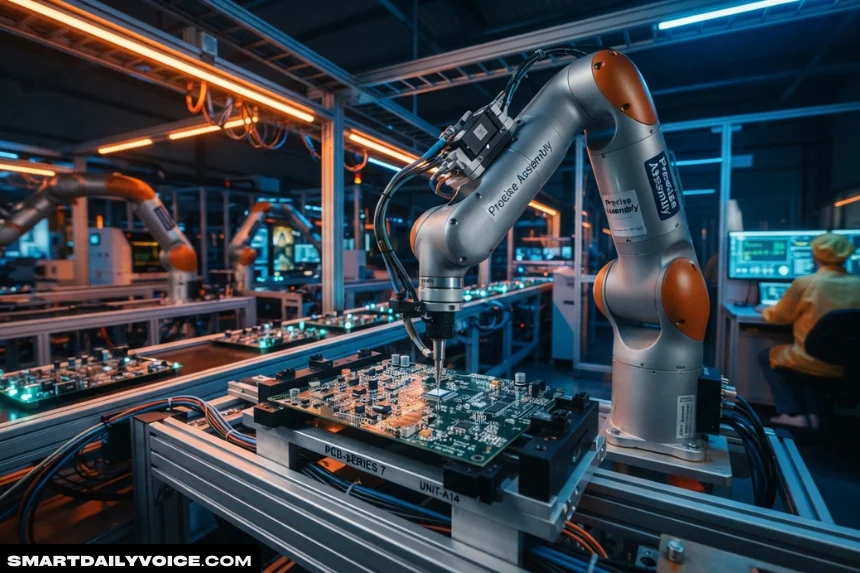
Similarly, factories use computer vision to inspect products. Predictive systems estimate equipment failure. Logistics companies optimize routes, inventory, and warehouse operations.
Robots can perform repetitive or dangerous tasks. Nevertheless, successful automation requires safe physical design, worker training, maintenance, and a plan for unusual conditions.
Transportation
In addition, AI supports navigation, traffic prediction, driver assistance, fleet maintenance, and autonomous-system research.
The level of autonomy matters. A feature that helps maintain lane position is not the same as a vehicle that can drive without human supervision in every environment. Marketing language should not replace the documented operating limits.
Agriculture
Meanwhile, farmers can use image analysis, sensors, and predictive models to identify crop stress, monitor livestock, estimate yield, and apply water or chemicals more precisely.
However, data quality, equipment cost, connectivity, and local conditions affect results. A model developed for one climate or crop may fail elsewhere.
Creative work and software
Generative tools assist with outlines, images, sound, video, prototypes, and code. They can reduce the time needed to explore options.
Still, professionals must check accuracy, originality, licensing, security, and audience suitability. An AI-generated code suggestion may contain a vulnerability, while generated visual material may imitate protected styles or reproduce unwanted stereotypes.
Cybersecurity
Security teams use models to identify unusual behavior, prioritize alerts, analyze malware, and support incident response. Attackers can also use AI to scale phishing, impersonation, vulnerability research, and social engineering.
Consequently, AI strengthens both defense and offense. Secure deployment requires access controls, data protection, monitoring, and careful testing of tool-enabled systems.
How AI Is Changing Work
AI changes work by affecting tasks, handoffs, workflows, skills, and management decisions. It does not affect every occupation in the same way.
Some tasks can be automated almost completely. Others become faster because AI provides a draft, recommendation, or analysis. Meanwhile, tasks involving physical dexterity, trust, accountability, negotiation, empathy, or unusual context may remain difficult to automate.
Automation, augmentation, and transformation
Automation removes or reduces human effort in a task. Augmentation helps a person perform the task. Transformation changes the workflow so substantially that the old task boundaries no longer make sense.
For example, a support agent may use AI to summarize a customer’s history. That is augmentation. A system may answer a simple request without an agent, which is automation. If the organization then redesigns routing, escalation, documentation, and quality review, it transforms the workflow.
Jobs are bundles of tasks
A job title can hide many activities. An accountant, teacher, nurse, designer, or software developer performs tasks with different levels of structure and risk.
Therefore, predictions based only on job titles can mislead. Organizations need to examine which tasks AI can perform, which tasks require human judgment, and how the handoff affects quality.
Productivity is not the only goal
A faster process can still be worse if it creates errors, reduces service quality, shifts work to customers, increases surveillance, or removes professional judgment.
Moreover, employees may spend saved time correcting weak output. Leaders should measure final outcomes, not only the speed of the AI-assisted step.
Skills that become more valuable
As routine generation becomes easier, several human capabilities gain importance:
- Framing the correct problem.
- Evaluating evidence.
- Understanding a domain.
- Detecting unusual cases.
- Communicating with affected people.
- Making accountable decisions.
- Designing reliable workflows.
- Protecting confidential information.
- Testing systems for failure.
- Knowing when not to automate.
AI literacy does not mean accepting every output. Instead, it means understanding capabilities, limitations, and appropriate verification.
AI in Healthcare
AI can support medical imaging, risk prediction, documentation, scheduling, research, drug development, public-health analysis, and patient communication. Nevertheless, healthcare is a high-impact domain in which an error can cause serious harm.
The World Health Organization has published guidance for large multimodal models in health. The guidance emphasizes governance because broad models may be used for diagnosis support, administration, education, research, and patient-facing communication without equal evidence for every task.
Potential uses
A validated imaging model may help identify patterns in scans. A documentation tool may turn a clinical conversation into a draft note. A research model may help scientists identify candidate molecules or summarize literature.
These uses can save time or expand analytical capacity. However, performance in one hospital, population, language, or device setting does not guarantee performance elsewhere.
Main healthcare risks
Medical data is sensitive. Models can expose information, encode unequal treatment, produce unsafe suggestions, or encourage users to delay professional care.
Moreover, a general-purpose chatbot may sound confident even when it lacks the patient’s complete history, examination, laboratory data, and local clinical guidance.
Safety note: AI-generated health information should not replace a qualified clinician’s diagnosis, emergency advice, or treatment plan. People should seek professional care for symptoms, medication decisions, or urgent concerns.

AI in Education
AI can provide tutoring, feedback, translation, accessibility tools, lesson support, and administrative assistance. It can help a learner ask questions privately and receive explanations in different formats.
However, the educational value depends on the activity. If a student uses a tool to explain a difficult concept and then solves the problem independently, AI may support learning. If the tool completes the assignment, the student may submit an answer without developing the intended skill.
Responsible classroom use
Teachers should define when AI is permitted, what disclosure is required, and which learning outcomes must remain human work. Students should verify sources and avoid entering private information.
In addition, schools need realistic assessment methods. Assignments may include oral explanation, drafts, reflection, in-class work, or project evidence rather than relying only on polished final text.
AI detectors are not a complete solution. False positives can harm students, especially when institutions treat an uncertain score as proof. Therefore, academic-integrity decisions should consider multiple forms of evidence and provide a fair review process.
AI in Science and Engineering
AI helps researchers analyze literature, interpret images, predict structures, model systems, design experiments, and search large spaces of possible materials or molecules.
The technology can narrow a set of candidates before expensive laboratory work. It can also identify patterns that are difficult to see manually.
Nevertheless, a model prediction is not a scientific result until researchers validate it. Data leakage, hidden benchmark overlap, weak baselines, irreproducible methods, or selective reporting can exaggerate progress.
Science requires transparent methods, uncertainty estimates, independent testing, and physical or experimental confirmation. AI can accelerate discovery, but it does not remove those requirements.
What Are the Benefits of AI?
AI offers real value when the system matches the problem and people manage the risks.
Speed and scale
Models can review more records, images, transactions, or documents than a person could process manually. This scale helps detect patterns and prioritize attention.
However, processing more information only helps when the system produces reliable signals. A high volume of weak alerts can overwhelm users.
Pattern detection
AI can recognize complex relationships across many variables. This ability supports forecasting, anomaly detection, perception, and scientific modeling.
Nevertheless, a statistical relationship may not be causal. Decision-makers still need domain knowledge and careful interpretation.
Accessibility
Speech-to-text, text-to-speech, translation, image description, and adaptive interfaces can improve access for people with disabilities or language barriers.
These tools should be tested with the communities they serve. Otherwise, errors in accents, dialects, terminology, or visual interpretation may exclude the same users the product intends to help.
Personalization
Systems can tailor recommendations, practice exercises, interfaces, or communication. Personalization may reduce irrelevant information.
However, personalization can also become manipulation, surveillance, or a filter that limits exposure to different options. Users need transparency and control.
Safer hazardous work
Robots and remote systems can support inspection, disaster response, mining, manufacturing, and other dangerous environments.
Still, physical AI requires strict safety engineering. A software error can become a physical accident when a model controls machinery.
Scientific and operational support
AI can reduce repetitive administration, support analysis, and help experts explore possibilities. This benefit may give professionals more time for complex work.
The gain is not automatic. Organizations often need to redesign processes, train people, improve data, and build quality controls before the technology produces meaningful value.
What Are the Risks and Disadvantages of AI?
AI risks come from models, data, human decisions, organizational incentives, deployment conditions, and malicious use. Therefore, safety is not only a technical property.
Inaccurate output and hallucinations
Generative models can produce statements that sound authoritative but are false. They may invent citations, confuse people, miscalculate, omit conditions, or combine unrelated facts.
This problem arises because a language model predicts plausible sequences rather than consulting a guaranteed truth database for every response. Retrieval and tool use can improve accuracy, but they can also fail.
Users should verify important claims with primary sources. High-impact systems should provide evidence, uncertainty, and a path for human review.
Bias and discrimination
Training data reflects society, including unequal treatment and missing representation. A model can learn those patterns.
Bias can also enter through labels, objectives, thresholds, product design, or deployment. For example, a system optimized for average accuracy may perform poorly for a smaller group.
Fairness requires more than removing protected attributes. Teams need representative evaluation, impact analysis, stakeholder participation, and monitoring after launch.
Privacy and data leakage
Prompts, uploaded files, conversation logs, training data, or tool outputs may contain personal or confidential information.
Users should not assume that every AI service offers the same storage, training, retention, or access controls. Before entering sensitive data, check the provider’s current terms and the organization’s policy.
Organizations should minimize data, restrict access, encrypt information, establish retention rules, and prevent employees from placing protected material into unapproved tools.
Cybersecurity and misuse
AI can improve defense, but it can also scale phishing, impersonation, fraud, reconnaissance, and malicious automation.
Tool-enabled agents create additional risk because they can access files, accounts, code, or external services. A prompt injection or mistaken instruction may cause unintended action.
Therefore, systems need least-privilege permissions, isolation, logging, human approvals, and secure software-development practices.
Deepfakes and misinformation
Synthetic audio, images, and video can imitate real people or events. The quality of a fake does not need to be perfect to cause harm; it only needs to create doubt or reach an audience before correction.
People should verify surprising media through reliable reporting, original sources, context, and multiple independent signals. Organizations should prepare impersonation-response plans rather than relying only on automated detection.
Copyright and ownership uncertainty
Generative AI raises questions about training data, output similarity, authorship, licensing, and responsibility. Laws and court interpretations vary by jurisdiction and continue to develop.
Therefore, businesses should not assume that generated output is automatically safe to publish or own. High-value commercial work may require provenance checks, licensing review, originality analysis, and legal advice.
Job disruption and worker surveillance
AI may automate tasks, change skill demand, create new roles, or reduce some positions. The result depends on industry, policy, bargaining power, workflow design, and business incentives.
The technology can also expand monitoring of employees. Productivity scoring, automated scheduling, or behavior analysis may reduce autonomy and increase pressure.
Responsible adoption should involve affected workers, define acceptable monitoring, provide training, and measure job quality as well as cost.
Overreliance and skill erosion
People may stop checking output when a system usually appears correct. This automation bias is dangerous because rare errors can be consequential.
In addition, constant outsourcing may weaken writing, calculation, navigation, memory, or professional judgment. A useful policy identifies which skills people must continue to practice independently.
Concentration of power
Advanced models require data, computing, talent, and capital. These requirements can concentrate influence in a small number of companies or governments.
Concentration affects competition, access, pricing, research independence, labor conditions, and public accountability. Open models may reduce some barriers, although they introduce their own security, maintenance, and governance questions.
Energy and environmental costs
AI training and use occur in data centers that consume electricity, cooling, hardware, and other resources. The impact varies greatly by model size, hardware efficiency, location, energy mix, workload, and utilization.
The International Energy Agency’s Key Questions on Energy and AI examines rapidly expanding data-center investment and electricity demand. At the same time, AI may help optimize grids, discover materials, improve forecasting, and reduce waste.
Therefore, the environmental debate should avoid one universal “energy per prompt” number. Organizations should measure actual workloads, improve efficiency, choose suitable model sizes, report resource use, and consider whether the task creates enough value to justify the cost.
Is AI Regulated?
AI regulation varies by country, sector, and application. Some laws address AI directly, while existing rules on privacy, discrimination, consumer protection, safety, intellectual property, employment, medical devices, and financial services also apply.
European Union
The EU AI Act uses a risk-based structure and applies in phases. According to the European Commission’s EU AI Act implementation timeline, major rules and applicable enforcement milestones began on August 2, 2026, while additional high-risk provisions continue on later dates.
Therefore, it is inaccurate to say that every requirement started at once. Organizations need to identify their role, system category, location, and applicable date.
United States
The United States has a mixture of federal guidance, agency enforcement, sector-specific rules, procurement requirements, state laws, and voluntary frameworks. The exact obligations depend on the use.
The NIST AI Risk Management Framework is a voluntary resource for identifying and managing AI risks. It organizes work around governance, context mapping, measurement, and risk management.
A voluntary framework is not a substitute for applicable law. However, it can help organizations build a repeatable process before a regulator, customer, or incident exposes a weakness.
Global ethical frameworks
UNESCO’s Recommendation on the Ethics of Artificial Intelligence emphasizes human rights, dignity, fairness, transparency, oversight, inclusion, and environmental sustainability.
These principles do not resolve every technical tradeoff. Nevertheless, they give governments and organizations a foundation for evaluating whether a system serves people rather than merely demonstrating capability.
How to Use AI Responsibly
Responsible use starts before a person enters a prompt or an organization buys a platform.
1. Define the purpose
State the problem, intended users, success criteria, and unacceptable outcomes. Do not deploy AI simply because competitors use it.
2. Classify the risk
A brainstorming assistant and a medical decision system require different controls. Consider the effect on rights, safety, money, health, education, employment, and access to essential services.
3. Choose the smallest suitable system
A specialized or smaller model may be cheaper, faster, more private, and easier to evaluate than a general-purpose system.
Therefore, match capability to need instead of treating scale as quality.
4. Protect sensitive data
Remove unnecessary personal information. Use approved services, access controls, retention limits, and secure integrations.
Employees should know which data can enter a tool and which data must remain outside it.
5. Keep a qualified human accountable
“Human in the loop” is meaningful only when the person has authority, time, knowledge, and evidence to challenge the system.
Do not place a nominal reviewer after an automated process while measuring that reviewer only on speed.
6. Verify consequential output
Check facts, calculations, citations, code, diagnoses, legal statements, and recommendations against authoritative sources or independent tests.
The higher the impact, the stronger the verification should be.
7. Test failure modes
Evaluate unusual inputs, adversarial prompts, demographic groups, language variation, distribution shifts, security attacks, and tool misuse.
Average performance can hide severe failures.
8. Disclose AI use where appropriate
People may need to know when they interact with a bot, receive synthetic media, or face an AI-supported decision.
Disclosure should be understandable and useful, not buried in a long policy.
9. Monitor after deployment
Track accuracy, complaints, incidents, drift, overrides, group performance, and unintended behavior.
Create thresholds that trigger investigation, restriction, retraining, or shutdown.
10. Provide correction and appeal
Affected people need a way to question the output and reach a responsible human.
Accountability becomes weak when no one can explain, correct, or reverse a harmful decision.
What Is the Future of AI?
The future of AI will likely involve broader capabilities, deeper integration, and more pressure for reliable governance. However, exact timelines remain uncertain.
More multimodal systems
Models will increasingly combine text, images, audio, video, sensor data, and actions. This integration may improve accessibility, robotics, research, and complex workflows.
Nevertheless, more input types also create more privacy, security, and evaluation challenges.
More AI agents
Agents may handle longer sequences of digital work. They could search, compare, draft, schedule, update records, and coordinate tools.
The practical question will not be whether an agent can complete a demonstration. Instead, organizations will ask whether it can operate reliably, securely, and economically over thousands of real cases.
Smaller and on-device models
Not every task needs a frontier model in a large data center. Smaller systems can run on phones, vehicles, equipment, or private servers.
On-device models may reduce latency and improve privacy. However, they still require updates, security, and careful performance testing.
More domain-specific AI
Healthcare, law, finance, manufacturing, science, and public services need specialized evidence and controls. General models may provide a foundation, while domain systems add trusted data, workflows, rules, and evaluation.
This direction may create more value than a single model attempting to perform every task.
Stronger evaluation
Benchmarks will continue to evolve, especially for reasoning, agents, safety, and real-world work. Developers will need tests that resist contamination and reflect actual operating conditions.
Moreover, independent evaluation and incident reporting may become more important as systems gain autonomy.
Human-centered workflow design
Organizations will move from adding a chatbot to one task toward redesigning complete processes. This shift can create larger benefits, but it also changes jobs and accountability.
Therefore, workers, customers, experts, and affected communities should participate in design rather than receiving a finished system after deployment.
Continued debate about AGI
Some researchers expect rapid progress toward broad machine capability, while others question definitions, measurements, economics, and real-world reliability.
No one can provide a dependable date for AGI. Consequently, society must prepare for multiple futures while addressing present harms and opportunities now.
AI FAQ
1. What does AI stand for?
AI stands for artificial intelligence. It describes a broad field of machine-based systems that produce predictions, recommendations, decisions, content, or actions from inputs.
2. How does AI work in simple terms?
AI systems use rules or learned patterns to convert input into an output. Machine-learning models train on examples, adjust internal values, and later apply those learned relationships to new data.
3. Is AI the same as machine learning?
No. AI is the broader field, while machine learning is one major approach within it. Some AI systems use explicit rules, search, optimization, or combinations of methods rather than machine learning alone.
4. What is generative AI?
Generative AI creates content such as text, images, audio, video, code, or designs. However, generated output can be inaccurate or unsuitable, so important work still requires verification.
5. Can AI think or feel like a human?
Current systems can perform tasks that appear intelligent, but no widely accepted evidence shows that they feel emotions or possess human-like consciousness. Fluent language should not be treated as proof of subjective experience.
6. Will AI replace human jobs?
AI will automate some tasks, support others, change workflows, and create new work. The effect on a specific job depends on its tasks, industry, adoption decisions, regulation, and the continued value of human judgment.
7. Is AI dangerous?
AI can cause harm through errors, discrimination, surveillance, privacy loss, cyberattacks, misinformation, unsafe automation, or malicious use. Nevertheless, risk varies by system and context, so governance should be proportional to the potential impact.
8. Why does AI give incorrect answers?
Many systems estimate a likely output rather than retrieving a guaranteed fact. Weak data, ambiguous instructions, missing context, model limitations, and changing conditions can all produce errors.
9. How can people use AI safely?
Avoid entering sensitive information, define the task clearly, verify important output, and keep a human responsible for consequential decisions. Moreover, use trusted primary sources for medical, legal, financial, and safety-related claims.
10. What is the future of AI?
Likely trends include multimodal models, agents, smaller on-device systems, domain-specific tools, scientific applications, stronger evaluation, and more regulation. However, precise capability and AGI timelines remain uncertain.
Conclusion
AI is a broad technological field, not a single product or digital mind. It can recognize patterns, generate content, support decisions, automate tasks, and extend human capabilities across work, science, healthcare, education, and daily life.
However, usefulness does not eliminate risk. AI can be wrong, biased, insecure, intrusive, expensive, or inappropriate for a high-impact decision. Therefore, the best approach combines technical capability with evidence, privacy protection, qualified human judgment, clear accountability, and continuous monitoring.
The central question is not whether AI is universally good or bad. Instead, people must ask which system is being used, for what purpose, with whose data, under which controls, and with what consequences when it fails.