





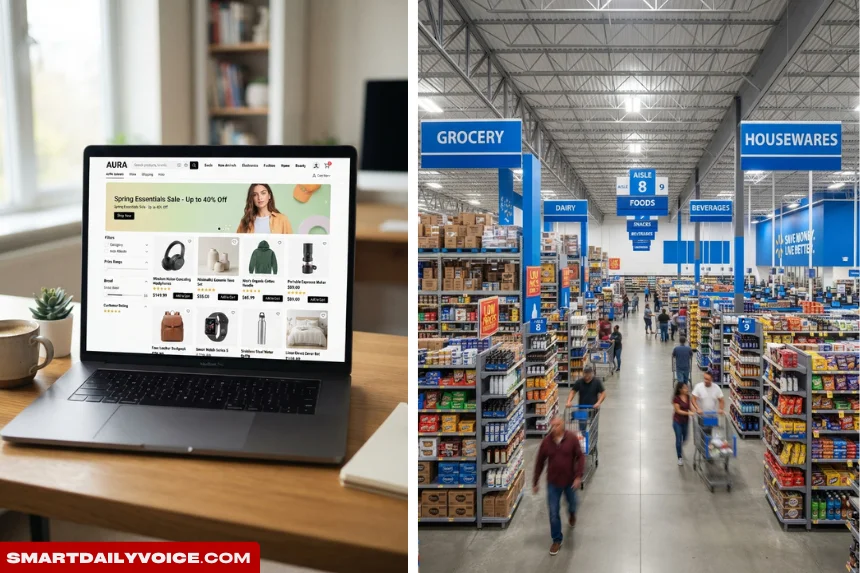
The main competitors of Amazon company are Walmart, Microsoft, Google, Alibaba, eBay, Target, Costco, Netflix, Apple, Meta, Shopify, Temu, TikTok Shop, and Mercado Libre. However, Amazon competes in many industries, so the answer depends on the business segment.
Amazon is not only an online store. It also runs a marketplace, cloud business, ad platform, streaming service, grocery business, device business, and logistics network. Amazon’s 2025 annual report says it competes across physical retail, ecommerce, omnichannel retail, media, search, social networks, ecommerce services, logistics, cloud, AI, devices, grocery, ads, and healthcare.
Therefore, the best way to understand Amazon’s competitors is to divide them by category.
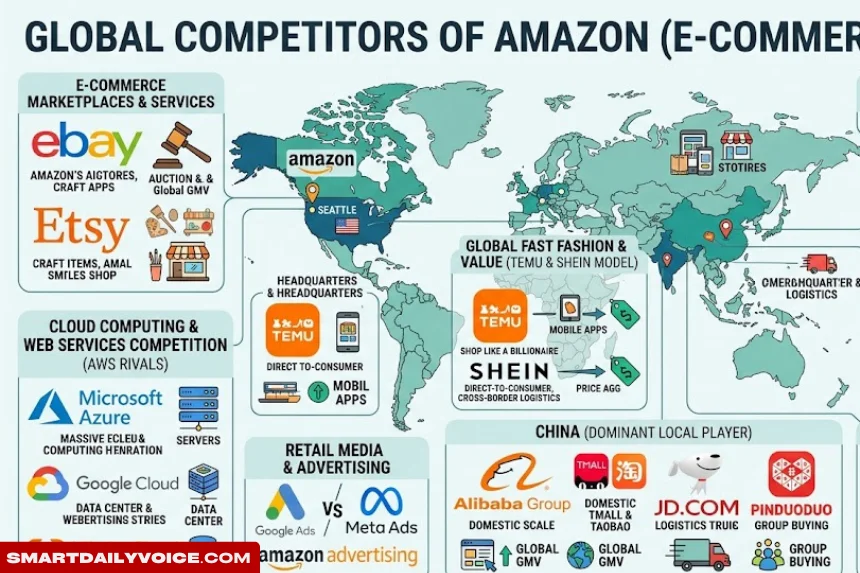
Quick Answer: Who Are the Main Competitors of Amazon Company?
The main competitors of Amazon company are Walmart in retail, Microsoft Azure and Google Cloud in cloud computing, Alibaba and eBay in ecommerce, Google and Meta in advertising, Netflix and Disney+ in streaming, and Shopify and TikTok Shop in seller-focused commerce.
| Amazon business area | Main competitors |
|---|---|
| Ecommerce | Walmart, Alibaba, eBay, Temu, Etsy, Mercado Libre, JD.com |
| Cloud computing | Microsoft Azure, Google Cloud, Oracle Cloud, IBM Cloud, Alibaba Cloud |
| Physical retail | Walmart, Target, Costco, Kroger, Best Buy |
| Advertising | Google, YouTube, Meta, TikTok, Walmart Connect |
| Streaming | Netflix, Disney+, Apple TV+, YouTube |
| Devices | Apple, Google, Samsung |
| Grocery | Walmart, Kroger, Costco, Target |
| Seller tools | Shopify, Walmart Marketplace, eBay, Etsy, TikTok Shop |
| Logistics | UPS, FedEx, Walmart fulfillment, Shopify partners |
Why the answer changes by segment
Amazon has different competitors because it operates in different markets. For example, Walmart competes with Amazon in retail and grocery. Microsoft competes with Amazon through Azure. Netflix competes with Prime Video. Meanwhile, Shopify competes with Amazon by helping brands sell through their own online stores.

Investopedia also divides Amazon’s competitors by revenue area, including online stores, physical stores, third-party seller services, advertising, subscription services, and AWS.
The top competitors of Amazon company depend on the market. Walmart is the biggest retail rival, Microsoft and Google challenge AWS, and Alibaba, eBay, Temu, Shopify, and TikTok Shop compete in ecommerce.
Why Amazon Has So Many Competitors
Amazon has many competitors because it runs many businesses at the same time. It sells products, hosts third-party sellers, operates physical grocery stores, sells ads, streams video, offers Prime, builds devices, provides cloud services through AWS, and runs a large fulfillment network.

Amazon is not just an online store
Amazon serves consumers through online and physical stores. It also sells devices such as Kindle, Fire TV, Echo, Ring, Blink, and eero. In addition, it produces media content and offers Prime benefits such as shipping, movies, series, live sports, and other perks.
Amazon competes with retailers and tech companies
Amazon’s competitors include both retailers and technology companies. For example, Walmart and Target compete in retail. Microsoft and Google compete in cloud. Meta and Google compete in ads. Netflix and Disney compete in streaming. Apple and Google also compete in devices and digital services.
Amazon’s own annual report confirms broad competition
Amazon’s annual report says the company faces a broad set of competitors from many sectors. It also says competitors may have stronger resources, older brands, more customers, better supplier terms, aggressive pricing, or more money for technology, infrastructure, fulfillment, and marketing.
Amazon has many competitors because it is a retail company, tech company, media company, ad company, logistics company, and cloud company at the same time.
Amazon’s Biggest Ecommerce Competitors
In ecommerce, Amazon competes most directly with Walmart, Alibaba, eBay, Temu, Etsy, Mercado Libre, and JD.com. These companies challenge Amazon through marketplaces, low prices, regional strength, seller tools, fast delivery, or niche product categories.
Walmart
Walmart is one of Amazon’s strongest ecommerce competitors in the United States. It has stores, grocery pickup, delivery, a growing marketplace, and a strong retail brand. Also, Walmart can use its store network as local fulfillment space.
Alibaba
Alibaba competes with Amazon through large ecommerce platforms and global trade services. It is especially important in China and cross-border commerce. However, Alibaba’s business model is different because it focuses heavily on marketplace and merchant services.
eBay
eBay competes with Amazon in marketplace selling. It is especially strong in collectibles, used goods, refurbished items, auto parts, and enthusiast categories. Investopedia also highlights eBay as a major third-party marketplace competitor.
Temu and PDD Holdings
Temu competes with Amazon by offering very low prices and a mobile-first shopping experience. Marketplace Pulse reported that Temu reached an estimated $22 billion in U.S. GMV in 2025. It also said Temu, TikTok Shop, and Walmart now compete in a similar $15 billion to $22 billion marketplace range.
Etsy
Etsy competes with Amazon in handmade, vintage, custom, and creative goods. Amazon has scale, but Etsy has a stronger identity for unique and personalized products.
Mercado Libre
Mercado Libre is one of Amazon’s most important regional competitors in Latin America. It combines marketplace selling, payments, logistics, and local market knowledge.
JD.com
JD.com competes with Amazon through ecommerce and logistics strength, especially in China. It has built a strong fulfillment network and competes in electronics, household goods, and consumer products.
Amazon still leads U.S. ecommerce, but Walmart, eBay, Temu, TikTok Shop, Etsy, Alibaba, JD.com, and Mercado Libre all compete for buyers and sellers.
Walmart vs Amazon: Amazon’s Biggest Retail Competitor
Walmart is often Amazon’s biggest retail competitor because it combines stores, ecommerce, grocery, pickup, marketplace selling, and fulfillment. Amazon has Prime and fast delivery, but Walmart has a large physical-store network that gives it strong local reach.
Walmart’s store advantage
Walmart’s biggest strength is its physical footprint. Stores help Walmart serve customers who want pickup, returns, grocery, and same-day local access. Amazon has fulfillment centers and Whole Foods, but Walmart’s stores give it a powerful local base.
Walmart Marketplace
Walmart Marketplace also gives third-party sellers another way to reach shoppers. This matters because many sellers want to reduce their dependence on Amazon.
Grocery competition
Grocery is one of Walmart’s strongest areas. Amazon owns Whole Foods and operates Amazon Fresh, but Walmart has long-term grocery habits, store access, and pickup options.
Walmart competes with Amazon because it blends online shopping with physical stores. That store network gives Walmart an advantage Amazon cannot easily copy.
Amazon Web Services Competitors
AWS competes with Microsoft Azure, Google Cloud, Oracle Cloud, IBM Cloud, and Alibaba Cloud. This competition matters because AWS is one of Amazon’s most important businesses and supports Amazon’s wider strategy.
Microsoft Azure
Microsoft Azure is AWS’s strongest cloud competitor. Azure benefits from Microsoft’s enterprise software relationships, Windows, Office, Dynamics, GitHub, and AI partnerships. As a result, many business customers compare AWS and Azure directly.
Google Cloud
Google Cloud competes through data tools, AI, analytics, Kubernetes, and developer services. It also benefits from Google’s AI research and cloud-native technology.
Oracle Cloud
Oracle Cloud competes strongly in databases and enterprise workloads. It appeals to companies that already use Oracle software.
IBM Cloud
IBM Cloud competes in hybrid cloud, enterprise IT, regulated industries, and consulting-led cloud projects.
Alibaba Cloud
Alibaba Cloud competes with AWS in Asia, especially in China and nearby markets. It matters for companies that need cloud infrastructure in those regions.
Statista reported in May 2026 that AWS held 28% of the worldwide cloud infrastructure market, ahead of Microsoft Azure at 21%. That shows AWS still leads, but Microsoft remains a major challenger.
AWS is Amazon’s cloud leader, but Microsoft Azure and Google Cloud are the biggest threats. Oracle, IBM, and Alibaba also compete in specific markets.
Amazon Advertising Competitors
Amazon’s advertising business competes with Google, YouTube, Meta, TikTok, and retail media networks such as Walmart Connect and Target Roundel. Amazon’s advantage is shopping intent because many users search Amazon when they are close to buying.
Google and YouTube
Google competes with Amazon through search ads. YouTube competes through video ads. Both platforms help advertisers reach people before and during buying decisions.
Meta
Meta competes through Facebook and Instagram ads. It has strong social data and visual ad formats. However, Amazon has stronger purchase-intent data because shoppers often search Amazon when they are ready to buy.
TikTok
TikTok competes through short-form video, creator content, and social commerce.
Retail media competitors
Retailers like Walmart, Target, Kroger, and Instacart are building ad businesses too. These retail media networks compete with Amazon because they also use shopping data to sell ads.
Investopedia lists Google, YouTube, Meta, and Viant as competitors for Amazon’s advertising services. Amazon’s annual report also says the company provides sponsored ads, display ads, and video advertising to sellers, vendors, publishers, and others.
Amazon ads compete with Google and Meta, but also with other retailers. Its biggest edge is that shoppers often search Amazon with buying intent.
Amazon Prime Video and Subscription Competitors
Amazon Prime competes with Netflix, Disney+, Apple TV+, YouTube, Walmart+, Costco memberships, and other subscription services. Prime is different because it bundles fast shipping, video, music, deals, and other perks into one membership.
Netflix
Netflix competes with Prime Video for streaming time and subscription budgets. It has a strong content library and a global streaming brand.
Disney+
Disney+ competes through franchises such as Disney, Pixar, Marvel, Star Wars, and National Geographic. It has strong family and franchise content.
Apple TV+
Apple TV+ competes through premium original shows and films. It also fits into Apple’s wider device and services ecosystem.
YouTube
YouTube competes for video attention. It is not the same as Prime Video, but it still competes for viewing time and ad dollars.
Walmart+ and Costco memberships
Walmart+ and Costco also compete with Prime in membership value. They do not offer the same bundle, but they compete for loyal shoppers and recurring membership spending.
Investopedia lists Netflix, Apple, and Google as subscription competitors for Amazon. Amazon’s annual report also describes Prime as a membership program that includes fast shipping, movies, series, live sports, and other benefits.
Prime competes with streaming platforms and retail memberships at the same time. That bundle makes Prime powerful, but it also gives Amazon many competitors.
Amazon’s Physical Retail and Grocery Competitors
In physical retail and grocery, Amazon competes with Walmart, Target, Costco, Kroger, and Best Buy. Amazon owns Whole Foods and operates Amazon Fresh, but traditional retailers still have strong store networks and customer habits.
Walmart
Walmart competes in grocery, stores, pickup, delivery, and marketplace selling. It is Amazon’s clearest physical retail rival.
Target
Target competes through stores, same-day services, apparel, home goods, private labels, and digital pickup options.
Costco
Costco competes through its membership warehouse model. It focuses on value, bulk buying, private-label products, and loyal members.
Kroger
Kroger competes strongly in grocery. It also has retail media and data services, which help it compete with Amazon in both grocery and ads.
Best Buy
Best Buy competes in electronics, appliances, tech support, and device sales. Amazon sells many electronics online, but Best Buy still has stores and service support.
Investopedia lists Costco, Target, Walmart, and Kroger as Amazon’s physical-store competitors.
Amazon has strong online reach, but physical retailers still compete well in grocery, pickup, returns, electronics, and local service.
Shopify, TikTok Shop, and Seller-Focused Amazon Competitors
TikTok and Shopify Shop compete with Amazon from a seller angle. Shopify helps brands build their own stores. TikTok Shop uses social discovery to drive sales. These platforms do not always match Amazon’s scale, but they give sellers alternatives.
Shopify
Shopify lets merchants run their own ecommerce stores. This makes it different from Amazon. Amazon owns the marketplace customer relationship, while Shopify helps brands own more of their customer data and storefront.
TikTok Shop
TikTok Shop connects entertainment and shopping. Sellers can reach buyers through short videos, creators, livestreams, and viral product discovery.
Walmart Marketplace
Walmart Marketplace gives sellers access to Walmart shoppers. It also helps sellers diversify away from Amazon.
eBay and Etsy
eBay and Etsy remain strong seller alternatives. eBay works well for used, collectible, and refurbished goods. Etsy works well for handmade, vintage, and custom items.
Marketplace Pulse reported that TikTok Shop and Walmart each reached about $15 billion in U.S. GMV, while Temu reached about $22 billion in 2025. That makes them smaller than Amazon, but still important competitors.
Seller-focused competitors matter because they give merchants more options. Amazon still has scale, but sellers increasingly use Shopify, Walmart, eBay, Etsy, and TikTok Shop too.
Amazon’s Competitive Advantages
Amazon’s biggest advantages are Prime, fast delivery, product selection, marketplace scale, customer data, AWS, advertising, and strong fulfillment. These strengths make Amazon hard to beat because few competitors can match its full business ecosystem.
Prime membership ecosystem
Prime keeps customers inside Amazon’s ecosystem. It combines shipping, video, deals, and other perks. Therefore, customers have more reasons to return.
Fast fulfillment and logistics
Amazon has built a large fulfillment network. This helps it offer fast and reliable delivery. Its annual report says retail competitive factors include selection, price, convenience, and fast, reliable fulfillment.
AWS profits and technology
AWS gives Amazon a major technology business. Amazon’s annual report says AWS revenue grew from $108 billion in 2024 to $129 billion in 2025. It also says AWS reached a $142 billion revenue run rate.
Customer trust and selection
Amazon offers a large product catalog, many sellers, customer reviews, fast delivery, and easy returns. These features make the platform convenient for buyers.
Amazon’s biggest advantage is its ecosystem. Customers can shop, stream, use devices, buy groceries, use cloud services, and interact with ads inside one large network.
Final List: Top Competitors of Amazon Company by Category
| Category | Top Amazon competitors |
|---|---|
| Ecommerce | Walmart, Alibaba, eBay, Temu, Etsy, Mercado Libre, JD.com |
| Cloud | Microsoft Azure, Google Cloud, Oracle, IBM, Alibaba Cloud |
| Ads | Google, YouTube, Meta, TikTok, Walmart Connect |
| Streaming | Netflix, Disney+, Apple TV+, YouTube |
| Retail | Walmart, Target, Costco, Kroger, Best Buy |
| Grocery | Walmart, Kroger, Costco, Target |
| Seller tools | Shopify, Walmart Marketplace, eBay, Etsy, TikTok Shop |
| Devices | Apple, Google, Samsung |
| Logistics | UPS, FedEx, Walmart fulfillment, Shopify logistics partners |
| Regional ecommerce | Mercado Libre, Shopee, Rakuten, Flipkart, JD.com |
Final Takeaway
The main competitors of Amazon company are Walmart, Microsoft, Google, Alibaba, eBay, Target, Costco, Netflix, Apple, Meta, Shopify, Temu, TikTok Shop, and Mercado Libre. However, no single company competes with Amazon everywhere.
Walmart is Amazon’s biggest retail competitor. Microsoft Azure and Google Cloud are AWS’s top cloud rivals. Google, YouTube, Meta, and TikTok compete with Amazon ads. Netflix, Disney+, Apple TV+, and YouTube compete with Prime Video. Shopify, TikTok Shop, Walmart Marketplace, eBay, and Etsy give sellers alternatives.
So, the best answer is simple: Amazon’s biggest competitor depends on the business segment.
FAQs
Who are the main competitors of Amazon company?
The main competitors of Amazon company are Walmart, Microsoft, Google, Alibaba, eBay, Target, Costco, Netflix, Apple, Meta, Shopify, Temu, TikTok Shop, and Mercado Libre. The exact competitor depends on the market.
Who is Amazon’s biggest competitor?
Walmart is often Amazon’s biggest retail competitor. However, Microsoft is one of Amazon’s biggest cloud competitors through Azure, while Google and Meta compete strongly in advertising.
Is Walmart Amazon’s biggest competitor?
Yes, Walmart is one of Amazon’s biggest competitors in retail, grocery, ecommerce, pickup, delivery, and marketplace selling. Its store network gives it a strong advantage in local shopping.
Who are Amazon’s ecommerce competitors?
Amazon’s ecommerce competitors include Walmart, Alibaba, eBay, Temu, Etsy, Mercado Libre, JD.com, TikTok Shop, and Shopify-powered stores.
Who competes with Amazon Web Services?
AWS competes with Microsoft Azure, Google Cloud, Oracle Cloud, IBM Cloud, and Alibaba Cloud. Microsoft Azure and Google Cloud are the strongest global rivals.
Who competes with Amazon Prime Video?
Prime Video competes with Netflix, Disney+, Apple TV+, YouTube, Max, Hulu, and other streaming services. Prime also competes with retail memberships such as Walmart+ and Costco.
Who competes with Amazon in advertising?
Amazon advertising competes with Google, YouTube, Meta, TikTok, Walmart Connect, Target Roundel, Kroger Precision Marketing, and other retail media networks.
Is Shopify a competitor of Amazon?
Yes, Shopify competes with Amazon from a seller and ecommerce platform angle. Shopify helps brands build their own stores instead of selling only through Amazon’s marketplace.
Is Alibaba a competitor of Amazon?
Yes, Alibaba is a major Amazon competitor in ecommerce, marketplace services, cross-border trade, and cloud services. However, Alibaba is strongest in China and parts of Asia.
Is Microsoft a competitor of Amazon?
Yes, Microsoft competes with Amazon mainly through Microsoft Azure, which challenges AWS in cloud computing, AI infrastructure, enterprise software, and developer services.
What companies are alternatives to Amazon for sellers?
Seller alternatives to Amazon include Walmart Marketplace, eBay, Etsy, Shopify, TikTok Shop, Temu, Mercado Libre, and niche marketplaces.
Why is Amazon hard to compete with?
Amazon is hard to compete with because it has Prime, fast delivery, a huge product catalog, strong logistics, AWS, customer data, advertising tools, and a large seller marketplace.
What is Amazon’s biggest competitive advantage?
Amazon’s biggest competitive advantage is its ecosystem. It combines retail, marketplace selling, Prime, logistics, AWS, ads, devices, streaming, and customer data.
Discover more on our website about barry switzer net worth