





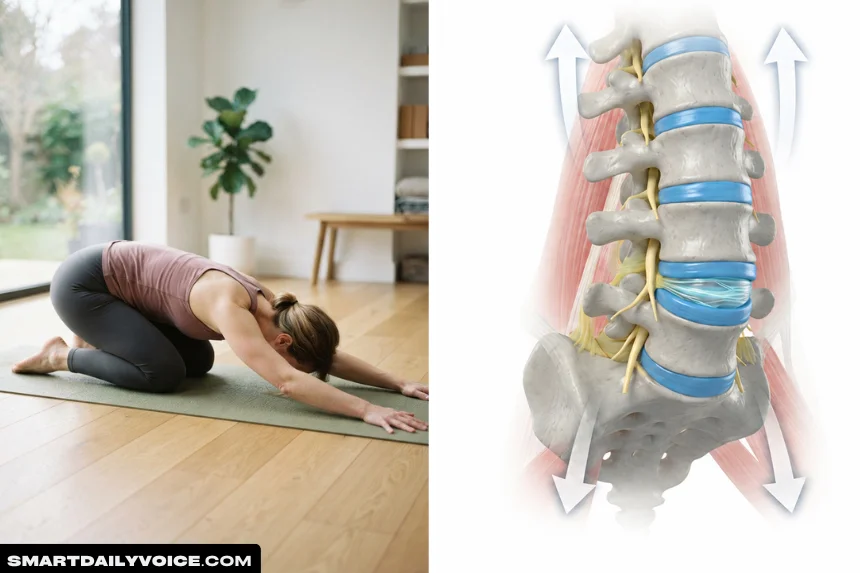
To decompress your spine at home, focus on gentle movement, comfortable resting positions and controlled stretches. These methods may reduce stiffness, ease muscle tension and temporarily lower the load on your back or neck.
However, home exercises do not permanently separate the vertebrae, reverse arthritis or push a herniated disc back into position. Medical professionals use the same phrase for traction therapy and surgery, but those treatments differ greatly from ordinary stretching.
Start with a brief walk, supported sleeping position, knee-to-chest stretch, pelvic tilt or kneeling back stretch. Move slowly, breathe normally and stop if pain becomes sharp, travels farther into an arm or leg, or appears with numbness or weakness.
Moreover, do not attempt traction after a serious fall, collision or recent spinal surgery. New bladder problems, bowel changes, saddle-area numbness or rapidly worsening leg weakness require emergency medical assessment rather than home treatment.
Medical note: This guide provides general health information. A doctor or physical therapist should assess persistent, severe or neurological symptoms.
What Does It Mean to Decompress Your Spine?
“Spinal decompression” can describe three different approaches:
| Approach | What it means |
|---|---|
| At-home unloading | Changing position or stretching to reduce stiffness and discomfort temporarily |
| Clinical traction | A therapist or machine applies a controlled pulling force |
| Decompression surgery | A surgeon removes tissue that presses on spinal nerves |
At-home movements may help tight muscles relax and make certain positions more comfortable. Nevertheless, they do not physically remove bone spurs, enlarged ligaments or disc material that compresses a nerve.
Clinical traction applies a pulling force to the lumbar or cervical spine. Some studies report short-term pain improvement in selected people with lower-back pain that travels into a leg. However, research has not shown reliable long-term benefits or consistent reduction in herniated-disc size. NICE therefore advises against routinely offering traction for low-back pain with or without sciatica.
Surgical decompression works differently. A surgeon enlarges the space around compressed nerves by removing part of a bone, ligament or disc. Doctors generally consider surgery when diagnosed nerve compression causes persistent or severe symptoms.
Can You Decompress Your Spine at Home?
You can use gentle positions and movements to make your spine feel less compressed. However, treat these methods as symptom-relief tools rather than structural cures.
They may help you:
- Reduce stiffness after prolonged sitting
- Relax tense back muscles
- Restore comfortable movement
- Find a less painful resting position
- Gradually return to daily activities
- Avoid the weakness associated with prolonged bed rest
For most uncomplicated back-pain episodes, medical guidance encourages people to stay active and continue normal activities as much as possible. Long periods in bed can increase stiffness and weaken the supporting muscles.
Still, no single exercise suits every condition. For example, someone with lumbar spinal stenosis may feel better while leaning forward, whereas another person may find repeated forward bending uncomfortable.
Before You Try Spinal Decompression Exercises
Avoid a self-directed routine until a healthcare professional assesses you when the pain began after:
- A car or motorcycle collision
- A fall from a significant height
- A forceful sports injury
- A direct blow to the neck or back
- Recent spinal surgery
- A known spinal fracture
High-energy trauma can damage vertebrae, nerves and nearby structures. Stretching or hanging before evaluation could aggravate an unstable injury.
You should also seek professional guidance first if you have severe osteoporosis, cancer involving the bones, inflammatory spinal disease, a diagnosed unstable vertebra or progressive neurological symptoms.
1. Take a Short, Gentle Walk
Start by changing position and walking for five to 10 minutes at a comfortable pace.
How to do it
- Stand slowly and allow your balance to settle.
- Walk around your home or on a level surface.
- Keep your steps short and relaxed.
- Let your arms move naturally.
- Stop if pain, tingling or weakness clearly increases.
Walking does not pull the vertebrae apart. Instead, it restores normal movement through the hips, pelvis and spine while preventing the stiffness that often develops after sitting or lying down.
Current NHS and orthopedic guidance recommends staying active during most ordinary back-pain episodes. AAOS also suggests combining aerobic activity, such as walking or swimming, with exercises that strengthen the abdominal and back muscles.
2. Lie on Your Back With Support Under Your Knees
A supported lying position may reduce muscular effort and make the lower back feel more comfortable.
How to position yourself
- Lie on your back on a supportive mattress or exercise mat.
- Bend your knees.
- Place one or two pillows beneath them.
- Allow your arms and shoulders to relax.
- Stay for five to 10 minutes while breathing normally.
- Roll onto your side before standing.
Alternatively, place your lower legs on a stable chair so your hips and knees remain comfortably bent.
This position does not permanently decompress the spine. However, supporting the knees can reduce the effort required to hold the legs and may help the lower-back muscles relax.
NHS patient guidance lists lying on the back with a pillow under the knees as one possible comfortable resting position. However, it also advises limiting bed rest and returning to movement regularly.
3. Sleep on Your Side With a Pillow Between Your Knees
Side sleeping may feel more comfortable when lying flat on your back increases tension.
How to set up the position
- Lie on whichever side feels more comfortable.
- Bend your hips and knees slightly.
- Place a pillow between your knees and thighs.
- Keep your shoulders and hips aligned.
- Use a head pillow that keeps your neck level.
- Avoid curling into an extremely tight position.
The pillow prevents the upper leg from dropping forward and twisting the pelvis excessively. As a result, some people feel less strain through the hips and lower back.
No sleeping posture can permanently decompress the spinal discs. Therefore, choose the position that allows you to rest comfortably rather than trying to maintain a rigid “perfect” alignment all night. NHS guidance suggests either a pillow beneath the knees while lying on the back or a pillow between the knees while lying on the side.

4. Perform a Single Knee-to-Chest Stretch
The knee-to-chest stretch gently moves the lower back and stretches muscles around the buttocks and hips.
How to do it
- Lie on your back with your knees bent.
- Keep both feet flat on the floor or bed.
- Bring one knee toward your chest.
- Hold behind the thigh or over the shin.
- Pull only until you feel a mild stretch.
- Hold for five to 20 seconds.
- Lower the leg slowly.
- Repeat up to five times on each side.
Several NHS physiotherapy resources include the knee-to-chest movement for lower-back mobility. They emphasize a gentle pull rather than forcing the knee tightly against the chest.
Avoid the movement if it increases leg pain, numbness or tingling. Likewise, do not assume that a stronger stretch creates more decompression.
5. Try Gentle Pelvic Tilts
Pelvic tilts move the lower spine through a small range while engaging the abdominal muscles.
How to do a pelvic tilt
- Lie on your back with your knees bent.
- Keep both feet flat and hip-width apart.
- Gently tighten your abdominal muscles.
- Flatten your lower back slightly toward the floor.
- Hold for two or three seconds.
- Release without forcing a large arch.
- Repeat five to 10 times.
Keep breathing throughout the exercise. The movement should remain subtle and controlled.
NHS lower-back guidance includes pelvic tilts as a mobility exercise. The goal involves restoring comfortable movement—not producing a crack or dramatic stretch.
If lying down feels uncomfortable, a physical therapist can show you a seated or standing variation.
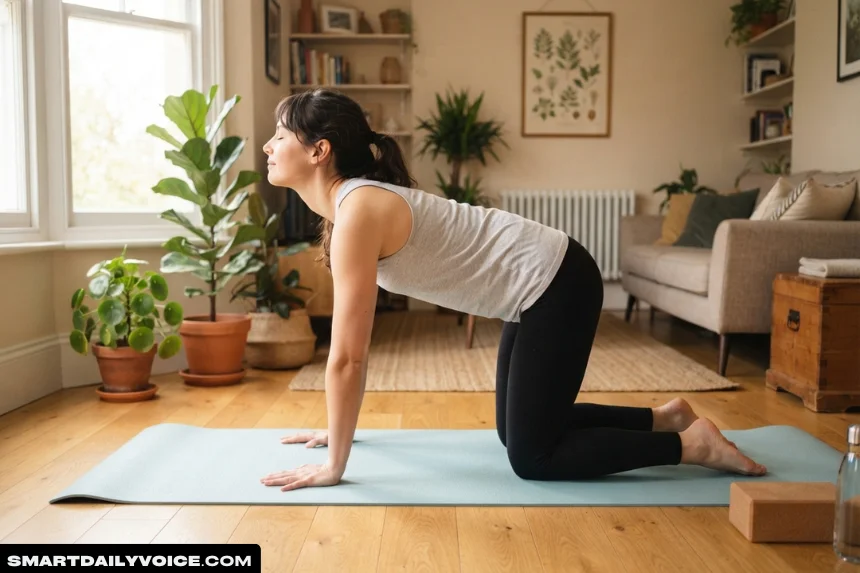
6. Use a Kneeling Back Stretch
A kneeling back stretch moves the lower back and hips without traction equipment.
How to do it
- Begin on your hands and knees.
- Position your hands beneath your shoulders.
- Keep your knees at a comfortable width.
- Slowly shift your hips backward toward your heels.
- Reach your hands forward.
- Hold for approximately five seconds.
- Return to the starting position.
- Repeat five to 10 times.
AAOS includes a similar movement in its Spine Conditioning Program. The instructions advise moving forward and backward gently while keeping the neck aligned with the spine.
Place a folded towel under your knees when necessary. However, skip this exercise if kneeling hurts your joints or forward bending makes symptoms travel farther down a leg.
7. Perform a Gentle Chin Tuck for Neck Tension
A chin tuck can improve neck positioning after prolonged computer or phone use. It provides a safer starting point than pulling on the head or using homemade cervical-traction devices.
How to do it
- Sit or stand upright.
- Look straight ahead.
- Keep your head level.
- Glide your chin gently backward.
- Avoid tipping your head down.
- Hold for three to five seconds.
- Relax and repeat five to 10 times.
You may feel a mild stretch at the back of the neck. However, the movement should not cause dizziness, headache, arm tingling or weakness.
NHS physiotherapy instructions describe chin tucks as a gentle backward movement performed without tilting the head downward.
Do not hang weights from your head, pull hard with a towel or allow another person to forcefully stretch your neck.

A Simple 10-Minute Spine-Unloading Routine
Someone with mild stiffness and no warning signs could try this sequence:
| Time | Movement |
|---|---|
| 3 minutes | Comfortable walking |
| 2 minutes | Supported lying with pillows under the knees |
| 2 minutes | Single knee-to-chest stretches |
| 1 minute | Pelvic tilts |
| 1 minute | Kneeling back stretch |
| 1 minute | Gentle walking before returning to normal activity |
You do not need to complete every step. Instead, choose the movements that feel comfortable and remove any exercise that consistently worsens your symptoms.
A mild stretch or temporary muscular ache may occur. Sharp pain, electric sensations, spreading numbness or new weakness require you to stop.
How Often Should You Decompress Your Spine?
No universal schedule works for every person or condition.
Begin with one short session. Then, notice how you feel during the exercise and over the next several hours. You can repeat comfortable movements once or twice daily, although doing them more often does not guarantee faster improvement.
A practical routine may include:
- Changing position every 30 to 60 minutes
- Taking several brief walks during the day
- Performing gentle mobility exercises once or twice daily
- Increasing repetitions gradually
- Adding strengthening when symptoms allow
- Taking breaks from movements that trigger a flare-up
Most importantly, do not rely entirely on passive stretching. Strong abdominal, back, hip and leg muscles help support normal movement and may lower the chance of recurring pain. AAOS recommends combining regular activity with exercises that build core strength and flexibility.
Can You Decompress Your Spine While Sleeping?
You cannot permanently decompress your spine while asleep. Nevertheless, a comfortable position may reduce muscular strain and improve rest.
Try one of these options:
- Back sleeping: Place a pillow under your knees.
- Side sleeping: Put a pillow between your knees and thighs.
- Front sleeping: Place a thin pillow beneath the abdomen only when this position feels comfortable.
- Reclined sleeping: Use a supportive adjustable bed or recliner temporarily if lying flat causes discomfort.
Mattress firmness alone does not determine whether a position will help. Your body size, symptoms, sleep habits and medical condition also matter.
Additionally, avoid spending the entire day in bed because your back feels better while lying down. Prolonged rest can increase stiffness and weaken the muscles needed for normal activity.
Does Hanging From a Bar Decompress Your Spine?
Hanging from a pull-up bar creates a type of vertical traction. Some people feel a temporary stretch, but research does not establish dead hanging as a reliable treatment for back pain, sciatica or disc herniation.
Traction research shows mixed results. Some reviews found possible short-term pain improvement in selected patients, while other evidence found little or no benefit. NICE advises against offering traction routinely for low-back pain and sciatica.
Hanging can also strain the:
- Shoulders
- Elbows
- Wrists
- Hands
- Grip muscles
Avoid it if you have shoulder instability, an upper-limb injury, weak grip, dizziness or worsening nerve symptoms. Furthermore, never jump into a hang or suddenly drop to the floor.
Do Inversion Tables Work?
Inversion tables tilt the body so the head moves below the feet. This position creates temporary traction, and some users report short-term relief.
However, inversion has not shown dependable long-term spinal decompression. Additionally, an inverted position can quickly increase pressure inside the eyes. A controlled study found that intraocular pressure rose substantially within five minutes of inversion.
Seek medical approval before using an inversion table, especially if you have:
- Glaucoma or retinal disease
- High blood pressure
- Heart or vascular disease
- A history of stroke
- Osteoporosis
- A spinal fracture
- Balance problems
- Pregnancy
Even without these conditions, use safety restraints and avoid starting in a fully inverted position.
Does Nonsurgical Spinal Decompression Work?
Many clinics use “nonsurgical spinal decompression” as a marketing term for motorized traction.
Evidence remains uncertain. A 2023 review found possible short-term pain relief for lower-back pain with lumbar radiculopathy. Nevertheless, the included studies varied in traction type and dosage, and short-term improvement did not prove lasting structural change.
Another review found short-term improvements but insufficient evidence that traction reduces the size of a herniated disc. Meanwhile, NICE recommends against routine traction for low-back pain with or without sciatica.
Be cautious when a provider promises to:
- Restore every damaged disc
- Permanently increase disc height
- Realign the entire spine
- Cure all sciatica
- Guarantee avoidance of surgery
- Produce permanent results within a fixed number of sessions
A supervised traction trial may help a selected patient feel better temporarily. However, it should not replace an accurate diagnosis, active rehabilitation or appropriate medical treatment.
Can Decompression Fix a Herniated Disc?
At-home decompression cannot guarantee that a herniated disc will return to its previous shape.
Many people improve with time, appropriate activity, physiotherapy and symptom management. Still, a herniated disc can irritate a nerve and cause pain, tingling, numbness or weakness in a leg.
Traction research has not demonstrated dependable long-term reduction in disc size. Therefore, judge progress by meaningful improvements—such as easier walking, less leg pain and better strength—rather than claims that someone has manually “put the disc back.”
Seek professional care when symptoms persist, progressively worsen or interfere with walking and daily activities.
What About Spinal Stenosis?
Lumbar spinal stenosis narrows the space around the spinal nerves. It may cause back pain, leg pain, numbness, weakness or heaviness during standing and walking.
Some people with stenosis feel better while sitting or leaning forward. However, that pattern does not prove a diagnosis because other back conditions can produce similar symptoms.
Treatment may involve:
- Activity modification
- Individualized exercise
- Physical therapy
- Medication
- Injections in selected cases
- Surgical assessment for severe nerve compression
Avoid repeatedly forcing the back into whichever position feels most “open.” Instead, a physical therapist can identify movements that suit your specific pattern.
When Does Surgical Decompression Become Necessary?
Doctors may consider decompression surgery when a physical examination and imaging confirm pressure on spinal nerves.
The NHS describes lumbar decompression as an operation that relieves symptoms caused by compressed nerves, including leg numbness or tingling. Surgeons may remove part of the vertebral bone, thickened ligament or damaged disc material to create more space.
Possible reasons for surgery include:
- Severe lumbar spinal stenosis
- A herniated disc causing significant nerve compression
- Progressive muscle weakness
- Persistent leg symptoms despite nonsurgical treatment
- Cauda equina syndrome
- Difficulty walking because of diagnosed nerve compression
Readers can review the NHS lumbar decompression surgery guide for information about the procedure, recovery and risks.
Surgery generally targets compressed-nerve symptoms more directly than ordinary muscular back pain. Therefore, a spine specialist should explain what surgery can and cannot improve.
When Should You Stop an Exercise?
Stop immediately when a movement causes:
- Sharp or electric pain
- Pain that travels farther into an arm or leg
- New or increasing numbness
- Muscle weakness
- Dizziness
- Loss of balance
- A severe headache
- Vision changes
- Difficulty walking
NHS guidance advises stopping back exercises when pain becomes worse and seeking medical advice.
A mild stretch does not need to feel completely effortless. However, the exercise should not create new neurological symptoms.
When Should You See a Doctor?
Arrange a healthcare appointment when back or neck symptoms:
- Continue for several weeks
- Repeatedly return
- Disrupt sleep or work
- Travel into an arm or below a knee
- Cause persistent numbness or tingling
- Limit walking
- Follow a fall or other injury
- Occur with unexplained fever or weight loss
- Develop in someone with a history of cancer
- Become steadily worse
Additionally, seek advice before starting exercises when you recently had surgery or received a diagnosis of osteoporosis, inflammatory arthritis or spinal instability.
When Is Back Pain an Emergency?
Seek emergency care for:
- New difficulty starting or controlling urination
- Loss of bladder or bowel control
- Numbness around the genitals, anus, buttocks or inner thighs
- New sexual dysfunction with back and leg symptoms
- Rapidly worsening weakness in one or both legs
- Severe symptoms in both legs
- Inability to walk safely
- Serious back pain after major trauma
These symptoms may indicate cauda equina syndrome, a rare but serious compression of the nerves at the lower end of the spinal canal. Delayed treatment can cause permanent bladder, bowel, sexual or leg dysfunction.
Do not try hanging, inversion or strong stretches while waiting to see whether these signs disappear.
Frequently Asked Questions
What is the fastest way to decompress your spine?
For mild stiffness, change position, take a brief walk and rest with support under your knees. No single method safely decompresses every spine, and forceful traction does not guarantee faster relief.
Can lying down decompress your spine?
Lying in a supported position may temporarily reduce muscle effort and loading. However, it does not permanently separate the vertebrae or reverse structural nerve compression.
How can I decompress my lower back in bed?
Lie on your back with a pillow beneath your knees or on your side with a pillow between your knees. Choose the position that feels most comfortable, and avoid remaining in bed throughout the day.
Can walking decompress the spine?
Walking does not mechanically pull the spinal joints apart. Nevertheless, it reduces prolonged stiffness, supports normal movement and helps people remain active during many uncomplicated back-pain episodes.
Is hanging good for spinal decompression?
Hanging creates traction but lacks strong evidence as a lasting treatment. It can also strain the shoulders, wrists and grip.
Can I decompress my neck with a towel?
Do not use forceful towel traction or homemade weights. Start with gentle movement and seek professional guidance when neck pain travels into an arm or causes weakness, numbness, dizziness or balance problems.
How long should I hold a decompression stretch?
Begin with five to 20 seconds for gentle stretches. Stop sooner if symptoms increase. The appropriate duration depends on the movement, your condition and professional guidance.
Can spinal decompression make pain worse?
Yes. Traction, inversion or stretching can aggravate certain disc, joint or nerve conditions. Stop when pain intensifies or spreads into a limb.
Do inversion tables permanently decompress the spine?
No dependable evidence shows permanent decompression. Inversion may also increase pressure inside the eyes.
Can decompression prevent back surgery?
Conservative treatment helps many people avoid surgery. However, progressive weakness, severe stenosis or emergency nerve compression may still require an operation.
Should I crack my back to decompress it?
A joint may make a popping sound during ordinary movement, but the sound does not prove that the spine has decompressed. Avoid forceful twisting or asking an untrained person to manipulate your back.
Conclusion
To decompress your spine safely at home, use gentle movement and comfortable positions rather than aggressive pulling.
Short walks, supported sleep positions, knee-to-chest stretches, pelvic tilts, kneeling back movements and chin tucks may reduce stiffness or muscle tension. However, they cannot permanently enlarge the spinal canal or reverse every disc problem.
Moreover, traction and inversion offer uncertain benefits and carry risks for some people. Lasting improvement often depends more on staying active, gradually strengthening supporting muscles and treating the actual cause of the symptoms.
Finally, seek emergency care for bladder or bowel changes, saddle numbness or rapidly worsening weakness. Those warning signs require immediate assessment rather than home decompression.