






If you are wondering what causes thick toenails, the leading possibilities are age-related nail changes, fungal infection, repeated pressure or injury, and psoriasis. Less common explanations include poor circulation, other inflammatory nail diseases, severe overgrowth, certain medical treatments, inherited disorders, and a growth beneath the nail.
However, thickness alone cannot identify the cause. Fungus, trauma, and psoriasis can all produce a yellow, crumbly, lifted, or misshapen toenail. This information was medically fact-checked through July 29, 2026.
Medical safety note: This article provides general education, not a diagnosis. Seek professional foot care if you have diabetes, neuropathy, poor circulation, immune suppression, or a previous foot ulcer. Promptly report spreading redness, pus, fever, severe pain, a new dark nail streak, unexplained bleeding, or a suddenly cold, pale, blue, or numb foot.
Quick answer
| Question | Answer |
|---|---|
| What causes thick toenails? | Common causes include aging, toenail fungus, repeated shoe pressure or injury, and psoriasis. |
| Are thick toenails always fungal? | No. Several nail conditions look similar. |
| Can aging cause thick nails? | Yes. Toenails often grow more slowly and become harder, duller, and thicker with age. |
| Can tight shoes cause them? | Yes. Repeated contact with the toe box can damage the nail and its growth center. |
| Can diabetes be involved? | Diabetes raises the risks of fungus, neuropathy, poor circulation, wounds, and infection, but it does not explain every thick nail. |
| When should you seek care? | Get help for pain, progressive change, infection, unsafe trimming, suspicious pigment, a nonhealing sore, or circulation symptoms. |
Key facts
| Fact | Detail |
| Medical term for simple thickening | Onychauxis |
| Common causes | Aging, fungus, trauma or pressure, psoriasis |
| Common fungal clues | Discoloration, crumbling, lifting, debris, athlete’s foot |
| Common trauma clues | One or two nails, tight footwear, sports, bruising, prior nail loss |
| Psoriasis clues | Pits, yellow-brown areas, lifting, thick scale, skin or joint symptoms |
| Important limitation | Appearance cannot reliably confirm fungus |
| Clinicians who evaluate nails | Primary-care clinicians, dermatologists, and podiatrists |
| Grow-out time | A damaged or treated toenail may take about a year or longer to replace itself |
What Are Thick Toenails?
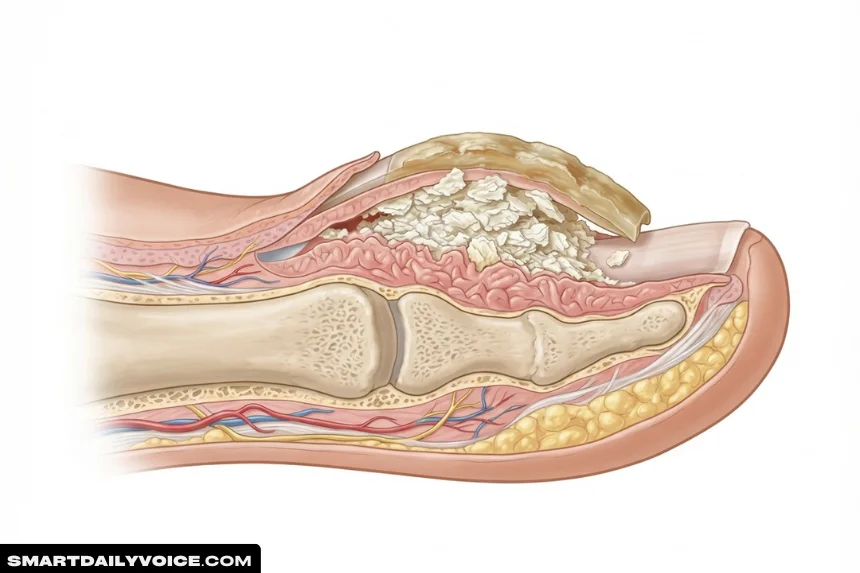
A thick toenail may have a genuinely thickened nail plate, a buildup of keratin beneath the nail, or both. For example, the descriptive medical term onychauxis often refers to simple nail-plate thickening.
Onychauxis is a finding, not a diagnosis. Therefore, the term does not tell you whether the cause is fungus, pressure, psoriasis, aging, or something else.
A severely thick, hard, curved nail is called onychogryphosis. People sometimes call this a “ram’s horn” nail because the nail can curl as it grows.

What Causes Thick Toenails Most Often?
Age-related changes, fungal nail infection, repeated trauma, and psoriasis account for many thick toenails. However, reliable sources differ on which is most common because they study different age groups and clinical populations.
| Cause | Pattern that may suggest it |
| Aging | Gradual hardening or thickening of several nails, slower growth, dull or yellowed appearance |
| Fungal infection | Yellow, white, or brown color; crumbling; lifting; debris beneath the nail; athlete’s foot |
| Repeated pressure or injury | One or a few nails, often the big or second toe; tight shoes, running, hiking, or a remembered impact |
| Psoriasis | Pits, yellow-brown “oil” areas, lifting, crumbling, and thick scale beneath the nail |
| Other inflammation | Roughness, ridges, splitting, or inflamed skin from eczema, lichen planus, or chronic nail-fold disease |
| Poor circulation | Thick or slow-growing nails with coolness, color change, reduced hair, walking pain, or nonhealing sores |
| Rare disorders or growths | Multiple very slow-growing yellow nails, lifelong thick nails, or one persistently distorted nail |
These clues are not a home diagnostic test. For example, an older runner can have age-related change, shoe trauma, and fungus in the same nail.
Can Aging Make Toenails Thicker?
Yes. Nails grow more slowly with age and may become harder, more opaque, brittle, yellowed, or thick. MedlinePlus describes these aging changes as potentially normal, especially in toenails.
In addition, years of shoe pressure and minor injuries accumulate. Meanwhile, older adults are also more likely to develop fungus, toe deformities, diabetes, or circulation problems. Consequently, age may contribute without being the only cause.
Do not dismiss a sudden or painful change as “just age.” New redness, drainage, a sore, pigment, or rapid distortion still needs assessment.
How Does Toenail Fungus Cause Thickening?
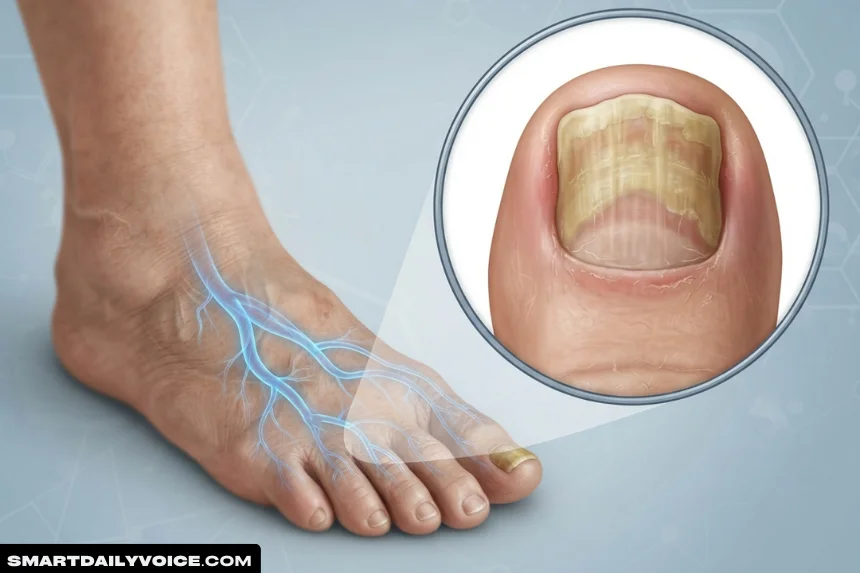
Toenail fungus, or onychomycosis, can invade the nail bed and plate. Over time, the nail may thicken, discolor, crumble, lift, or collect debris underneath.
The American Academy of Dermatology’s fungal-nail signs include color change, brittleness, buildup, lifting, misshapen growth, and pain in more severe cases. In addition, athlete’s foot, sweaty footwear, shared damp floors, and nail injury can increase risk.
Nevertheless, yellow plus thick does not prove fungus. Psoriasis and trauma can look nearly identical, while more than one condition can occur at once.
For that reason, clinicians may test nail scrapings or clippings before prescribing months of treatment. The American Family Physician evidence review recommends confirmation because treatment is lengthy and may have adverse effects.
Can Tight Shoes, Running, or an Injury Thicken a Toenail?
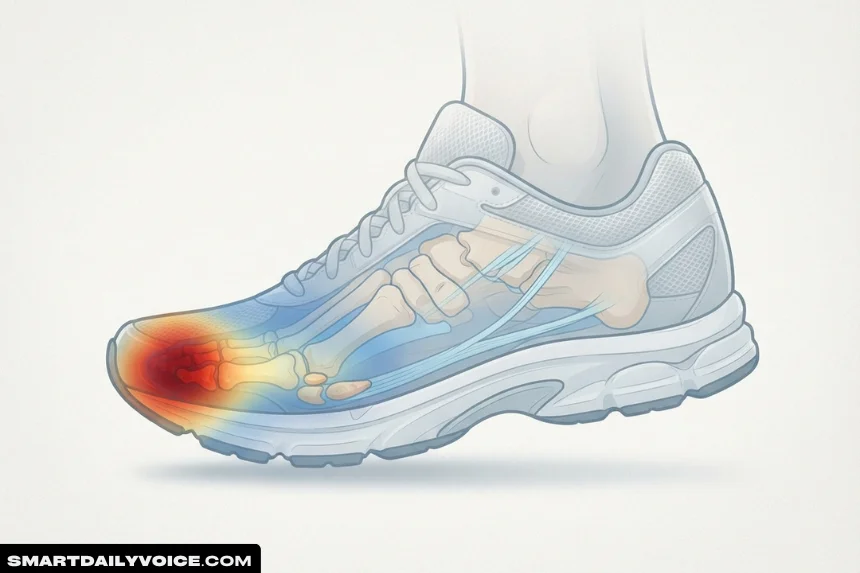
Yes. A heavy object, stubbed toe, or sudden stop inside a shoe can injure the nail. Repeated low-level pressure can do the same thing more gradually.
For example, runners, hikers, dancers, soccer players, and people who work on their feet may repeatedly strike the toe box. Meanwhile, a short, narrow, or shallow shoe can press the big toenail or second toenail during every step.
A bunion, hammertoe, or overlapping toe may change the pressure pattern. As a result, one nail may bruise, lift, fall off, or grow back thicker.
If the nail matrix scars, abnormal growth can persist. Wider or deeper footwear can prevent more trauma, but it cannot always reverse existing matrix damage.
Can Psoriasis and Other Skin Conditions Thicken Toenails?
Yes. Nail psoriasis can cause thickening, small pits, yellow-brown discoloration, crumbling, and separation from the nail bed. The National Psoriasis Foundation’s nail guide notes that nail psoriasis and fungal infection can resemble each other and can coexist.
Psoriasis elsewhere on the skin supports the diagnosis, although nail disease can occasionally appear without obvious plaques. Joint pain, morning stiffness, or a swollen finger or toe should also be mentioned because nail psoriasis can occur with psoriatic arthritis.
Other inflammatory disorders may alter the nails as well. Similarly, eczema can produce pits, ridges, thickening, and discoloration, while lichen planus may cause ridging, splitting, thinning, or scarring.
Are Thick Toenails a Sign of Diabetes or Poor Circulation?
Sometimes they accompany these conditions, but a thick nail alone cannot diagnose either one. Diabetes raises the likelihood of fungal infection, neuropathy, peripheral artery disease, wounds, and serious foot infection.
Peripheral artery disease reduces blood flow to the legs and feet. MedlinePlus lists thick toenails among possible PAD findings, along with cool or discolored feet, hair loss, weak pulses, activity-related leg pain, and slow-healing sores.
Therefore, the surrounding symptoms matter more than nail thickness by itself. A clinician may check foot pulses, skin temperature, sensation, wounds, and blood pressure at the ankle when circulation is a concern.
Foot care also requires more caution in diabetes. The NIDDK diabetes foot-care guidance advises professional trimming when someone cannot see, feel, or reach the feet or when toenails are thick or yellowed.
What Less Common Conditions Cause Very Thick Nails?
Several less common conditions can produce marked thickening.
- Onychogryphosis: The nail becomes very thick, hard, overgrown, and curved. Aging, repeated pressure, limited nail care, psoriasis, trauma, and circulation problems may contribute.
- Yellow nail syndrome: Several nails turn yellow, thicken, and grow very slowly. Leg swelling or respiratory symptoms may occur, so one yellow nail is not enough to suggest this rare syndrome.
- Medical treatments: Chemotherapy and some medicines can alter the growth, color, texture, or attachment of several nails.
- Inherited nail disorders: Rare genetic conditions may cause thick nails from childhood, often with other skin or foot findings.
- Nail-unit growths: A benign growth can distort one nail, while cancer beneath or around a nail is uncommon but important to recognize.
A new or changing brown or black band needs particular attention. The American Academy of Dermatology’s nail-melanoma warning signs also include dark skin beside the nail, lifting, splitting, and a bump beneath it.
What Clues Suggest Fungus, Trauma, Psoriasis, or Aging?
The distribution and accompanying signs may narrow the possibilities. However, no row in this table confirms a diagnosis.
| Pattern | More suggestive of | Why it is not conclusive |
| Yellow-brown, crumbly nail with debris and athlete’s foot | Fungus | Psoriasis and trauma can also discolor and crumble nails. |
| One big or second toenail after sports or tight shoes | Repeated trauma | A damaged nail is also more vulnerable to fungus. |
| Gradual thickening of several toenails over years | Aging | Fungus becomes more common with age. |
| Pits, lifting, skin plaques, or inflammatory joint symptoms | Psoriasis | Fungus may coexist with psoriasis. |
| Thick nail plus cold foot, reduced hair, walking pain, or a sore | PAD | A vascular examination is needed. |
| New dark band, adjacent skin pigment, lump, splitting, or bleeding | Nail tumor or melanoma concern | Many pigment changes are benign, but examination is essential. |
In particular, one-nail changes deserve careful attention when there is no clear injury. Meanwhile, changes across many nails may point toward aging, psoriasis, medication effects, or a less common systemic process.
How Do Thick Toenails Change Over Time?
The course depends on the cause, so there is no universal timeline.
| Stage | What may happen |
| Initial trigger | Trauma can cause bruising or lifting quickly; fungus and aging may begin without pain. |
| Following weeks or months | Altered nail grows forward; discoloration, ridges, debris, or thickening becomes more visible. |
| Ongoing exposure | Continued shoe pressure, untreated inflammation, or infection may increase distortion and discomfort. |
| After treatment or pressure relief | Clearer nail must grow from the base; a toenail may need about a year or longer to replace itself. |
The old abnormal section does not instantly become normal when treatment starts. Moreover, a nail may remain thick if the matrix is scarred or the original cause continues.
How Does a Clinician Diagnose a Thick Toenail?
A clinician starts with the history and pattern. They may ask when the change began, which nails changed, whether there was trauma, what shoes and activities are involved, and whether athlete’s foot, psoriasis, joint symptoms, diabetes, or circulation problems are present.
Next, they examine the nail, surrounding skin, spaces between the toes, and other nails. In addition, a podiatrist or clinician may assess footwear, toe deformity, pulses, sensation, and wounds.
When fungus is possible, a scraping or clipping can undergo microscopy, culture, special staining, or molecular testing. Testing matters because antifungal pills and lacquers will not treat psoriasis or permanent trauma.
A dermatologist may use magnification to assess pigment or a growth. If a tumor is possible, a biopsy or imaging study may be necessary.

How Are Thick Toenails Treated?
Treatment targets the cause rather than thickness alone.
- Fungus: Prescription topical medicine may suit mild disease, while oral antifungal medicine may work better for more extensive infection. Oral drugs can interact with other medicines and may require liver assessment.
- Trauma: Better-fitting shoes, pressure reduction, activity adjustments, and careful nail thinning can prevent further injury. Permanent matrix damage may not fully reverse.
- Psoriasis: A dermatologist may use topical treatment, injections, light-based therapy, or systemic medication depending on the nails, skin, joints, and overall health.
- Age-related thickening: Regular trimming, filing, or professional debridement can improve comfort and shoe fit.
- PAD or high-risk diabetes: Clinicians address the underlying disease and protect the skin from cuts, ulcers, and infection.
- Suspicious growth or pigment: Dermatologic investigation comes before cosmetic filing or antifungal treatment.
Do not expect an overnight result. Instead, even after a cause is controlled, the damaged nail must grow forward.
How Can You Cut or Thin Thick Toenails Safely?
If you have normal sensation and circulation and can reach the foot securely, wash and dry your feet first. Then use clean, sturdy toenail clippers or nippers and make several small cuts straight across.
Gently file sharp edges afterward. In addition, choose shoes with enough length, width, and depth to keep the toes from striking the upper or front.
Do not dig beneath the nail, tear lifted sections, cut deeply into the corners, or grind until the nail feels hot. Also, do not share nail tools, and clean them between uses.
Professional trimming is safer when the nail is too hard to control or when vision, reach, tremor, sensation, or circulation is impaired. People with diabetes, neuropathy, PAD, prior ulcers, or immune suppression should ask their care team before attempting aggressive thinning.
When Should You See a Doctor?
Make a routine appointment if the nail keeps thickening, becomes painful, interferes with walking or shoes, or is too difficult to cut safely. A clinician can also help when self-treatment for presumed fungus has failed.
Seek prompt or same-day care for redness, warmth, swelling, pus, worsening pain, fever, an open sore, or a thick nail cutting into the skin. The threshold should be especially low with diabetes, neuropathy, poor circulation, or immune suppression.
Arrange a dermatologist visit for a new or changing dark streak, pigment spreading onto nearby skin, a bump beneath the nail, or unexplained splitting or bleeding. Finally, seek emergency care for a foot that suddenly becomes cold, pale, blue, weak, very painful, or numb.
Frequently Asked Questions
1. What causes thick toenails?
Common causes include aging, fungal infection, repeated pressure or injury, and psoriasis. Less common causes include other inflammatory nail diseases, poor circulation, severe overgrowth, medicines, inherited disorders, and nail-unit growths.
2. Are thick toenails always caused by fungus?
No. Trauma, aging, and psoriasis can closely resemble toenail fungus. Therefore, a clinician may test a clipping or scraping before recommending long-term antifungal treatment.
3. Why do toenails get thicker with age?
Toenails grow more slowly with age and may become harder, duller, and more opaque. In addition, years of shoe pressure, minor injuries, fungus, and health conditions can contribute.
4. Can tight shoes cause thick toenails?
Yes. Repeated contact with a short, narrow, or shallow toe box can injure the nail and matrix. The big or second toenail is often affected.
5. Does diabetes cause thick toenails?
Diabetes does not directly explain every thick nail. However, it increases the risks of fungus, neuropathy, PAD, wounds, and infection, so professional foot-care advice is important.
6. How can I tell toenail fungus from trauma?
Fungus often causes progressive discoloration, crumbling, lifting, and debris, sometimes with athlete’s foot. Trauma more often affects a pressure-bearing nail after an impact, sport, or tight footwear, but laboratory testing may still be needed.
7. Can psoriasis make toenails thick?
Yes. Nail psoriasis can cause thickening, pits, yellow-brown areas, crumbling, and lifting. Moreover, psoriasis and fungal infection can occur together.
8. Can I thin a thick toenail at home?
Some people can make small straight cuts and file the nail gently. However, professional care is safer if the nail is painful or extremely hard, or if you have diabetes, neuropathy, poor circulation, impaired vision, or prior ulcers.
9. What can soften very hard toenails?
Washing the feet and trimming after the nail has absorbed some moisture may make cutting easier. Clinicians may also recommend a high-strength urea product, but use it only as directed and avoid applying strong keratolytic products to broken skin.
10. When should I see a doctor about a thick toenail?
Seek care for progressive thickening, pain, suspected infection, unsafe trimming, a wound, or a change that affects one nail without a clear reason. A dark streak, nearby skin pigment, lump, unexplained bleeding, or sudden circulation symptoms needs faster evaluation.
11. What causes thick toenails without a fungal infection?
Besides fungus, aging, repeated injuries, tight shoes, and psoriasis can make toenails thicker. A healthcare professional can help identify the exact cause.
12. What causes thick toenails on only one foot?
A thick toenail on one foot may result from repeated pressure, an old injury, or a localized fungal infection. Seek medical advice if it becomes painful, dark, or inflamed.
13. What causes thick toenails to become yellow and crumbly?
A fungal infection commonly causes thick, yellow, or crumbly toenails. However, psoriasis and nail trauma can look similar, so proper testing may be needed before treatment.
Conclusion
The clearest answer to what causes thick toenails is that aging, fungal infection, repeated trauma, and psoriasis lead the list. Nevertheless, color and thickness cannot reliably separate those causes.
Safe care depends on the diagnosis and the health of the foot. Therefore, get professional advice for persistent changes, suspected fungus, high-risk medical conditions, infection, suspicious pigment, wounds, or reduced blood-flow symptoms.